Sprinklr Pricing: What It Costs Now That Self-Serve Has Ended
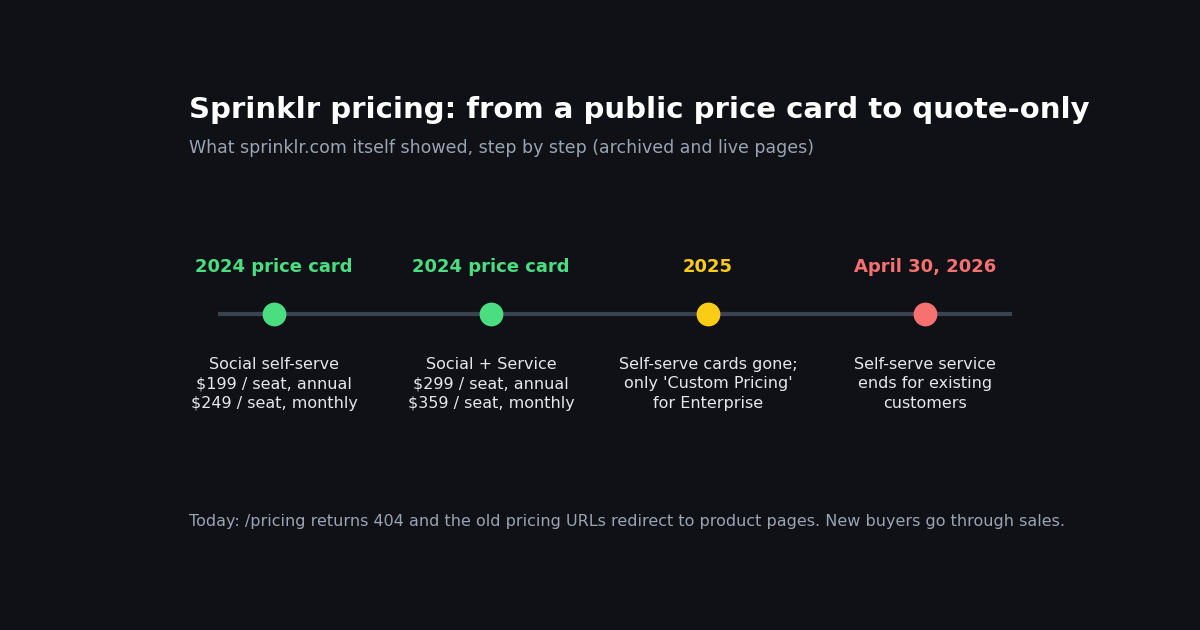
- No public price: Sprinklr sells Social, Service, Insights and Marketing by custom quote;
sprinklr.com/pricing/returns 404 and the old pricing URLs redirect to product pages. - Self-serve is over: Sprinklr's notice said self-serve products were discontinued, with service for existing customers ending on April 30, 2026.
- Last list prices (2024 archive of Sprinklr's own page): Social self-serve $199 a seat a month annual or $249 monthly; Social + Service $299 annual or $359 monthly.
- Seat math on those old prices: three Social seats were $597 a month ($7,164 a year) on annual billing; enterprise quotes start from a different, unpublished base.
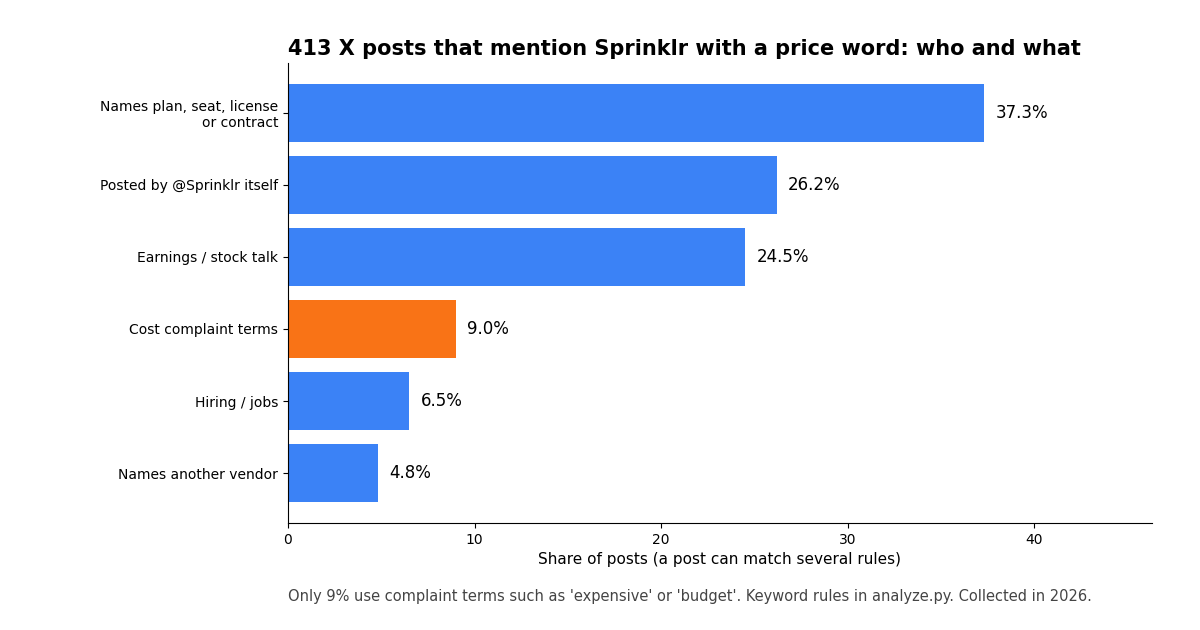
- Our study: of 413 X posts that name Sprinklr with a price word, 26.2% came from @Sprinklr itself, 24.5% were stock or earnings talk, and only 9.0% used complaint terms such as
expensiveorbudget. - X data alone: 1,000 tweets a day is about $4.50 a month at $0.15 per 1,000 tweets returned, vs $150 at the X API's $0.005 per post read.
Sprinklr is an enterprise customer experience suite: social publishing and engagement (Sprinklr Social), contact-center and care tools (Sprinklr Service), listening and consumer intelligence (Sprinklr Insights) and campaign tools (Sprinklr Marketing), all on one platform it calls Unified-CXM. Buyers searching for its price usually find review sites quoting old numbers, because Sprinklr itself stopped publishing any.
This page reconstructs what Sprinklr published and when, from Sprinklr's own live and archived pages, explains how an enterprise quote is put together, runs the seat math on the last public prices, and then prices the narrowest slice many teams actually need: posts on X that mention a brand. Every Sprinklr fact below was checked this session on sprinklr.com or an archived copy of it; every X number comes from our own study, collected in 2026.
9.0% of 413 posts; 26.2% came from @Sprinklr itself and 24.5% were stock talk. Collected in 2026.
Sprinklr pricing today: quote-only, no public plans
As of our check this session, Sprinklr publishes no price for any product. The URL sprinklr.com/pricing/ returns HTTP 404. The four product pricing URLs that existed until 2025 (/pricing/social-media-management/, /pricing/consumer-intelligence/, /pricing/customer-service/ and /pricing/marketing-and-advertising/) now answer with a 301 redirect to the matching product page, and none of the 3,507 URLs in Sprinklr's main sitemap is a pricing page.
The only buying path on the site is a demo form titled "Get Pricing & Personalized Demo". In other words, the price is whatever the sales conversation produces.
Why this matters for a buyer. Without a list price there is no anchor in the negotiation, and every number you read on a third-party review site is either historical (the self-serve prices below) or an estimate. Treat such estimates as estimates, and ask Sprinklr for a written quote that separates seats, modules and channels.
The last published Sprinklr prices (self-serve, 2024)
An archived copy of Sprinklr's own Social pricing page from August 2024 (Internet Archive snapshot of sprinklr.com/pricing/social-media-management/) shows three cards: two self-serve plans with list prices and an Enterprise card with "Custom Pricing". The self-serve cards offered a 30-day free trial with no credit card and said "Monthly billing only via credit card" under each plan.
Social Media Management ($199 annual, $249 monthly). Omnichannel publisher, multi-timezone calendar, Sprinklr AI+ for content creation, approval workflows, smart AI scheduling, a digital asset manager, social listening topics and themes, 10+ brand reports for listening and benchmarking, AI-powered listening alerts, an omnichannel inbox with AI message sorting, and organic and paid reports. The card advertised "Save 20%" for annual billing.
SMM and Customer Service ($299 annual, $359 monthly). Everything above plus care on 15+ channels, chatbots, a knowledge base, skill-based routing, guided paths, CSAT surveys, SLA and business hours, APIs and webhooks, and customer service reports. Labeled "Most popular", with "Save 17%" for annual billing.
What changed in 2025. A May 2025 snapshot of the same URL shows only the Enterprise card with "Custom Pricing" and "Contact Sales": the two self-serve cards were gone. By September 2025 the archive records the URL as a redirect, which is what it still does today.
Sprinklr self-serve was discontinued: what that means
Sprinklr's own notice page (archived from sprinklr.com/free-trial-to-demo/, now a redirect to the demo form) read: "Self-Serve products have been discontinued. This enables us to focus our innovation efforts on our Sprinklr Enterprise platform offering." It added that existing Sprinklr Self-Serve customers would see service "continue uninterrupted until the end of service on April 30, 2026", with questions going to their Sprinklr contact.
For new buyers. There is no card-on-file plan to start with. A small team that used to pay $199 or $249 a seat a month now has two choices: an enterprise contract, or a different tool.
For former self-serve customers. The self-serve terms that remain online say fees in an order are non-cancelable and non-refundable, subscriptions renew at the selected interval, and Sprinklr has no obligation to retain content after termination. Export reports, assets and inbox history before access ends; the terms state that content is deleted after termination.
For anyone reading old reviews. Any page that quotes $199, $249, $299 or $359 as "Sprinklr pricing" is quoting the discontinued self-serve plans, not what an enterprise quote will look like.
How a Sprinklr enterprise quote is built
Sprinklr does not publish its enterprise price list, so the structure below is what its own product pages and the archived Enterprise card describe, not a price sheet. The Enterprise card listed 30+ channels with custom channels, a custom editorial calendar, in-depth listening (voice of the customer, brand monitoring, crisis management, competitor insights), an omnichannel inbox for 30+ channels, unified reporting across paid, owned and earned media, social advertising, employee advocacy and social customer service.
Seats. The self-serve terms define a user as "an individual user who is authorized" and state that the plan determines the number of user seats; sharing logins is prohibited. Expect enterprise quotes to scale with named users too.
Modules. Social, Service, Insights and Marketing are separate products on the site. A team that wants publishing plus listening plus care is buying several modules, not one plan.
Channels and volume. Ask how listening is sized (mentions processed, sources covered, or both). Ask how X (Twitter) data is counted, because X data has its own cost upstream.
Term and payment. The self-serve terms show USD billing, auto-renewal and no refunds for prepaid fees. Ask whether the enterprise contract is annual or multi-year, and get the renewal cap in writing.
Services. Sprinklr sells training and professional services; onboarding for a multi-brand rollout is usually a separate line item.
Third-party pricing guides that rank for this query publish enterprise estimates in the tens of thousands of dollars a year. Sprinklr does not confirm any of these figures, so we do not repeat them as fact; use them only as a prompt to ask sales for a full written quote.
Seat math on the last public prices
The old self-serve prices are the only Sprinklr numbers ever printed on sprinklr.com, so they are the only fair basis for seat math. Enterprise quotes are not comparable, but these totals show how quickly per-seat pricing grows with a team.
Per month, per the 2024 archive of Sprinklr's own page. Three Social seats on annual billing came to $7,164 a year; three Social + Service seats on monthly billing came to $12,924 a year.
The monthly premium. On Social, monthly billing cost $50 more per seat a month ($600 a seat a year); on Social + Service it cost $60 more ($720 a seat a year).
What that buys. Seats bought publishing, an inbox, reports and listening for every network the suite covered. If your team uses the suite every day across several networks, seat pricing is the price of the workflow. If the only output anyone reads is a feed of X posts that mention your brand, you are paying seat prices for a data job.
Study: what X says when Sprinklr and price come up
Pricing pages for Sprinklr often cite "Reddit and X users" complaining about cost. We checked what X actually holds. We searched X for posts that name Sprinklr together with a price word (price, pricing, cost, expensive, contract, license, seat, budget, cheap) and classified the 413 posts returned with transparent keyword rules. The posts came from 228 distinct accounts; 94.4% were in English.
Reading the numbers. The price conversation about Sprinklr on X is thin: 413 matching posts spread over years, not days. About a quarter is the company's own marketing and another quarter is investor talk about the listed company. Explicit cost complaints are a minority at 9.0%, and some of those use budget in a neutral sense. Head-to-head comparisons with named rivals are rarer still, at 4.8%.
The vendor's own account. @Sprinklr had 37,876 followers at collection. Its latest 200 posts covered 590 days (about 0.34 posts a day), 67.0% carried media, none were replies, and only 5 of 200 used a word such as price, plan, trial or self-serve. The median post drew 4 likes and 432 views. Pricing news, including the end of self-serve, did not run through the brand's X feed.
What the X (Twitter) slice of listening costs on its own
Many teams evaluate Sprinklr for one job: catch every X post that mentions the brand, a product or a competitor, and push it into a dashboard, a warehouse or an alert channel. That job is a data bill, priced per post, not a seat bill. Using the brief's rate cards, at 30 days a month:
Per 1,000 tweets, the official X API pay-per-usage rate card (docs.x.com/x-api/getting-started/pricing) is $5 and TwitterAPI.io is $0.15, about 33x apart. The X pay-per-usage plan is capped at 3 million post reads a month, which the 100,000-a-day row reaches; above that, X sends you to Enterprise.
Polling floor. A search that returns nothing is billed at the 15-credit minimum, $0.00015. One query checked every 60 seconds for a month is 43,200 checks, $6.48 if every check came back empty; every 5 minutes it is $1.30. Real bills are that floor plus $0.15 per 1,000 tweets actually returned.
What you build yourself. Sentiment, dashboards, routing and a reply inbox are not included in a data API. A developer usually wires search results into an existing BI tool, a database or a Slack or Discord channel. If you need all of that across many networks with governance and approvals, a suite is the product; if you need X posts in your own systems, the data route is the product.
Credits and billing. $1 buys 100,000 credits, purchased credits never expire, and new accounts that pass the automatic bot check get up to $1 of free credits (at most 100,000 credits, no card, one per person or network, expiring after 31 days). Reads need no X account. Rate limits start at 0.2 requests a second before the first payment and rise to 20 once paid.
When Sprinklr is worth it, and when to skip it
Large, multi-brand organizations running social, care and listening in one place. Sprinklr's pitch is one platform across 30+ channels, global governance and approval workflows. If dozens of teams and hundreds of accounts share one system, an enterprise contract can be the right purchase, and the quote is the price of that consolidation.
Small teams that liked the old self-serve plan. That plan is gone. Look at seat-priced suites that still publish prices (our Sprout Social and Talkwalker pricing pages list them), and compare total seats times price with what you paid Sprinklr.
Teams that only need X mentions. A seat plan is more than the job needs. A scheduled search per keyword on the advanced search endpoint, billed per tweet returned, returns the raw posts at the per-tweet prices in the table above, and you keep the data.
Analysts and researchers. If the deliverable is a dataset (a crisis timeline, a campaign analysis, a competitor share-of-voice count), pulling the posts directly is usually simpler than licensing a suite for the project.
Questions to ask Sprinklr sales. Per-seat price by module; how listening volume is counted and what happens above it; which X data is included and whether historical search is extra; renewal cap; minimum term; onboarding fees; and what happens to your data at termination.
How we collected this
Question. What does X hold when people talk about Sprinklr's price, how much of it is the company itself or investor talk, and how often do posts complain about cost? Secondary: how active is the @Sprinklr account and does it discuss pricing?
Accounts and query. One organization account, @Sprinklr: a profile lookup plus its latest 200 posts from the user timeline endpoint. One search on the advanced search endpoint (Latest), sprinklr (price OR pricing OR cost OR costs OR expensive OR contract OR license OR seat OR seats OR budget OR cheap), followed to the last page the search returned.
Window and sample. The most recent matching posts at collection time, collected in 2026: 413 search posts from 228 accounts, and 200 timeline posts. About 60 to 80 read requests in total, roughly $0.20 of credits.
Method. Each post was tested against five regular-expression rules (cost complaint, plan or contract terms, another vendor named, stock or earnings, hiring) and tagged if it came from @Sprinklr. The rules are printed in results.json; a post can match several. Keyword rules miss sarcasm and catch neutral uses ("budget" in a planning post), so treat the shares as an upper bound for complaints.
What the sample cannot show. Search returns what X's search index returns for that query, not every post ever written; complaints made in private, in sales calls or on other networks are invisible here; and the study says nothing about what any specific customer pays.
Privacy. Aggregates only. Only the @Sprinklr organization account is named. Search results (whose authors are private individuals) were kept out of the repository; the published sample holds de-identified rows with no ids, URLs, text or handles.
import os
import re
import time
import requests

BASE = "https://api.twitterapi.io"
HEADERS = {"X-API-Key": os.environ["TWITTERAPI_IO_KEY"]}

# The X slice of a listening setup: one query per brand, own posts excluded.
QUERIES = {
    "Sprinklr": "(sprinklr OR @Sprinklr) -from:Sprinklr",
    "Price talk": "sprinklr (price OR pricing OR cost OR expensive OR contract OR license OR seat)",
}
COMPLAINT = re.compile(r"\b(expensive|overpriced|pricey|too much|costly|budget)\b", re.I)


def search(query, max_pages=5):
    """Yield tweets newest first, following next_cursor until has_next_page is false."""
    cursor = ""
    for _ in range(max_pages):
        r = requests.get(
            f"{BASE}/twitter/tweet/advanced_search",
            headers=HEADERS,
            params={"query": query, "queryType": "Latest", "cursor": cursor},
            timeout=30,
        )
        r.raise_for_status()
        body = r.json()
        for t in body.get("tweets", []):
            yield t
        if not body.get("has_next_page"):
            break
        cursor = body.get("next_cursor", "")
        time.sleep(5)  # 0.2 requests/s before the first payment


for label, q in QUERIES.items():
    tweets = list(search(q))
    complaints = sum(1 for t in tweets if COMPLAINT.search(t.get("text", "")))
    replies = sum(1 for t in tweets if t.get("isReply"))
    print(f"{label}: {len(tweets)} posts, {replies} replies, {complaints} with cost-complaint terms, "
          f"data cost ${len(tweets) * 0.15 / 1000:.4f} at $0.15 per 1,000 tweets")
    for t in tweets[:3]:
        print("  ", t["createdAt"], t.get("likeCount", 0), "likes |", t["text"][:80].replace("\n", " "))
Researching this?Free starter credits cover end-to-end testing — Google sign-in, no card. Get a key.
Questions readers ask
How much does Sprinklr cost per month?
Sprinklr publishes no price. All products are sold by custom quote after a demo. The last public prices were the self-serve plans in 2024: $199 a seat a month (annual) or $249 (monthly) for Social, and $299 or $359 for Social plus Service. Those plans have been discontinued.
Does Sprinklr still have a self-serve plan or free trial?
No. Sprinklr's notice said self-serve products were discontinued, with service for existing self-serve customers ending on April 30, 2026. The free-trial page now redirects to a demo request form.
Why does sprinklr.com/pricing show a 404?
The general /pricing/ URL returns 404 and the product pricing URLs redirect to product pages. Since self-serve ended, Sprinklr only sells enterprise contracts, so there is no price card to show.
What is Sprinklr's pricing model?
Enterprise subscriptions, usually annual, sized by named user seats and by the modules you buy (Social, Service, Insights, Marketing), with listening sized by volume and sources. The remaining self-serve terms show USD billing, auto-renewal and non-refundable fees.
How much does Sprinklr social listening cost?
There is no published listening price. Listening sits in Sprinklr Insights and in the enterprise Social bundle, both quote-only. The discontinued self-serve Social plan at $199 to $249 a seat included basic listening topics and AI alerts.
Is there a cheaper way to monitor X (Twitter) mentions than Sprinklr?
For X alone, yes: pulling posts with a data API costs $0.15 per 1,000 tweets returned on TwitterAPI.io, or $5 per 1,000 on the official X API rate card. 1,000 posts a day is about $4.50 a month on the former. You build the dashboard or alerts yourself.
What do people on X say about Sprinklr's pricing?
Less than you might expect. In our sample of 413 posts naming Sprinklr with a price word, 9.0% used complaint terms such as expensive or budget, while 26.2% came from Sprinklr itself and 24.5% were stock or earnings talk.
Continue
- X developer docs: X API pricing (pay-per-usage rate card, 3M post read cap)
- TwitterAPI.io docs: Advanced Search endpoint
- TwitterAPI.io API documentation
- X developer docs: building a search query
- TwitterAPI.io pricing and credit packs
- X (Twitter) API overview: endpoints and pricing
- Sprout Social pricing: plans, seats and listening
- Talkwalker pricing and what X listening costs
- X API options for social listening compared
- Meltwater alternative for X media monitoring
- TwitterAPI.io pricing: pay only for the data returned
- 01PhantomBuster Pricing: Plans, Execution Hours and What X (Twitter) Data Really Costs
- 02Goose MCP: How to Add MCP Servers (Extensions) to goose, Desktop and CLI
- 03ChatGPT Apps SDK Tutorial: Build a ChatGPT App That Answers With Live Twitter (X) Data
- 04LM Studio MCP: Connect MCP Servers (and Live Twitter (X) Data) to a Local Model
- 05Ollama MCP: How to Give a Local Model MCP Tools (with Live Twitter (X) Data)
- 06Warp Pricing in 2026: Plans, Dollar Usage, Add-ons and the Real Monthly Bill
- 07Cursor Pricing in 2026: Plans, the Weekly Usage Pool, Worked Monthly Bills and the Cost of Adding Twitter (X) Data
- 08Codex Pricing in 2026: ChatGPT Plans, Usage Limits, Credits and API-Key Costs
Writing about something you built with TwitterAPI.io? Our community rewards program pays API credits for honest tutorials, build logs and videos.
Stop reading. Start building.
Starter credits cover real testing on real data. Google sign-in, no card, no application queue.
Get an API keyAlready building with TwitterAPI.io? Publish an honest tutorial or build log about it and earn up to $200 a month in API credits.