Zernio Alternative for Twitter (X) Data: Pricing, API Scope and Real Workload Costs
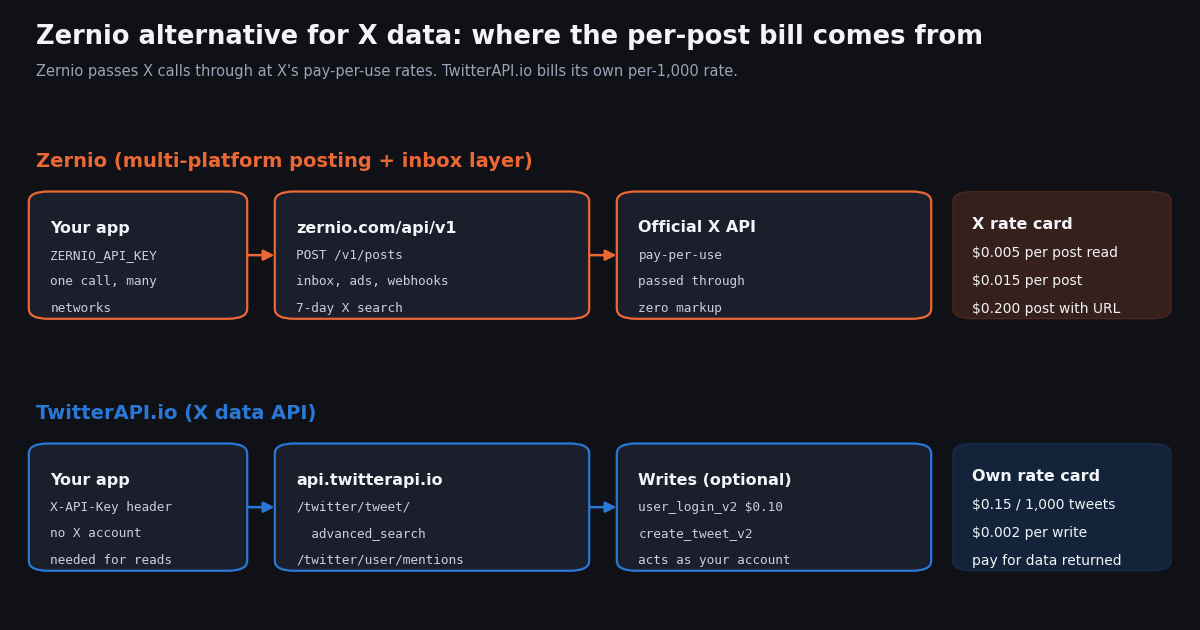
This page is about Zernio the product: what it is, what Zernio pricing looks like for X specifically, what its API can and cannot do on X, and what the same X workload costs on an X-only data API. If you want the general how-to of scheduling or auto-posting tweets (inside X, from an RSS feed or a spreadsheet, or from code), our Twitter auto-post guide covers that; here the question is narrower: you are looking at Zernio, and you want to know whether its X bill makes sense for what you plan to do.
Every fact about Zernio below was read from its own pricing page, docs and rebrand notice in 2026, and every X price from X's developer documentation. The cost comparison is not a guess at a typical customer: we pulled the recent timelines and inbound mentions of 12 brand and SaaS accounts on X, measured how much each one posts and how much it gets mentioned, and priced that monthly workload twice, once at X's pay-per-use rates (which Zernio passes through) and once at TwitterAPI.io's rates.
Short version: Zernio is a multi-network publishing and inbox layer, and on X it is a pass-through to the official API. For publishing the same post to many networks, that is useful. For reading X at volume, the pass-through rate card is the cost driver, and an X-specific data API changes the math by more than an order of magnitude.
What Zernio is (and the Late to Zernio rebrand)
Zernio describes itself as one API to "publish posts, run inboxes, place calls and manage ads" across many platforms. Its docs (docs.zernio.com) show a single create-post call (a POST to the posts resource under https://zernio.com/api/v1) that publishes now or on a schedule to 16 social platforms, an inbox for DMs, comments and reviews, phone numbers with calls, SMS and WhatsApp, ad campaigns, and webhooks such as post.published, message.received and account.disconnected. Official SDKs exist for Node, Python and Go.
The rebrand is real and documented. Zernio's own notice at my.zernio.com/rebrand states that Late is now Zernio, with the same API, team and infrastructure. getlate.dev permanently redirects to zernio.com, the docs moved from docs.getlate.dev to docs.zernio.com, the Node SDK moved from @getlatedev/node to @zernio/node, the Python SDK from late-sdk to zernio-sdk, the environment variable from LATE_API_KEY to ZERNIO_API_KEY, and the base URL from https://getlate.dev/api/v1 to https://zernio.com/api/v1. The notice lists endpoints, API keys, webhooks, rate limits, connected accounts and pricing as unchanged, and gives old SDK package names a six-month grace period. The stated reason: "Late" was a generic word that was hard to find in search.
Why that matters for searchers. If you are migrating code that still says getlate.dev or LATE_API_KEY, nothing breaks today, but the package names and variable you see in tutorials will differ. Searches for "late api" and "getlate" now land on the same product.
How Zernio talks to X. Zernio's docs describe X as a connected account: you authorize an X account, and Zernio performs X operations on its behalf through the official X API. Its X read endpoints, such as recent search, take an accountId too. That is the key difference from an X data API, where reads need only an API key and no X account at all.
Zernio pricing, line by line
Zernio's pricing page (zernio.com/pricing) says there are no plans or seats: it is one usage-based platform with every feature on every account. The bill has these parts.
The X line is the one that scales with usage. Zernio's table lists X reads (posts, analytics, lists) at $0.005, user reads, follows and Article actions at $0.010, posts and DM sends at $0.015, and posts with a URL at $0.200. Its FAQ explains why X is separate: "X (Twitter) charges per API call on their end. We pass through their exact rates with zero markup so you only pay for what you use. Analytics and inbox sync for X accounts are opt-in, so you control the costs." The docs also expose an X pricing endpoint (billing/x-pricing), which returns the same table with markup: "0%", and an X API spend cap that answers HTTP 402 once reached for the billing period.
Zernio's table says "per request"; X's rate card says "per resource". X's pricing page bills reads per resource returned (each post, each user) and writes per request, and Zernio says it passes X's exact rates through. On a single-tweet lookup the two are the same thing; Zernio's docs for that endpoint say it is "billed as an X posts read ($0.005)" and that repeat lookups of the same tweet within the same UTC day are charged once. In the comparison below we price reads the way X's rate card does, per post returned.
What Zernio's free tier covers. The first two connected accounts are free with unlimited posts, analytics and the full API, per the pricing FAQ. X API costs are still passed through on those accounts, so a single-brand X setup pays no account fee but pays X's rate card for every X call.
What Zernio does and does not do on X
Zernio's X surface, from its docs: publish and schedule posts (including X Articles, which need an X Premium subscription on the connected account), look up a tweet by ID or URL, search recent tweets, retweet and undo, bookmark, follow and unfollow, read and reply to comments, read and send DMs, and run X Ads.
Search is recent-only and per connected account. The search-tweets endpoint searches "public tweets from the last 7 days matching an X search query", passes the query to X unchanged, requires an accountId, takes a limit with a minimum of 10, and is rate-limited to 300 requests per 15-minute window per connected account. Its docs frame it as a way "to discover tweets to reply to".
Several X limits come from X itself. Zernio's docs note that X's encrypted "X Chat" messages are not accessible through the API, so some DM conversations show only outgoing messages; that DM write endpoints require X API Pro or Enterprise access for customers who bring their own X keys; that X comment polling is off, so comment-triggered automations refuse X accounts with a 400; and that X's DM API allows 200 requests per 15 minutes and 1,000 per 24 hours per connected account.
What is not in the docs. We found no X endpoints in Zernio's docs for reading an arbitrary account's timeline, reading follower or following lists of another account, or pushing new tweets from accounts or keywords you do not own to a webhook. Zernio's webhooks fire on events in your own connected accounts (a post published, a message received). For listening and research jobs, that is the gap an X data API fills.
The study: what a brand's monthly X workload looks like
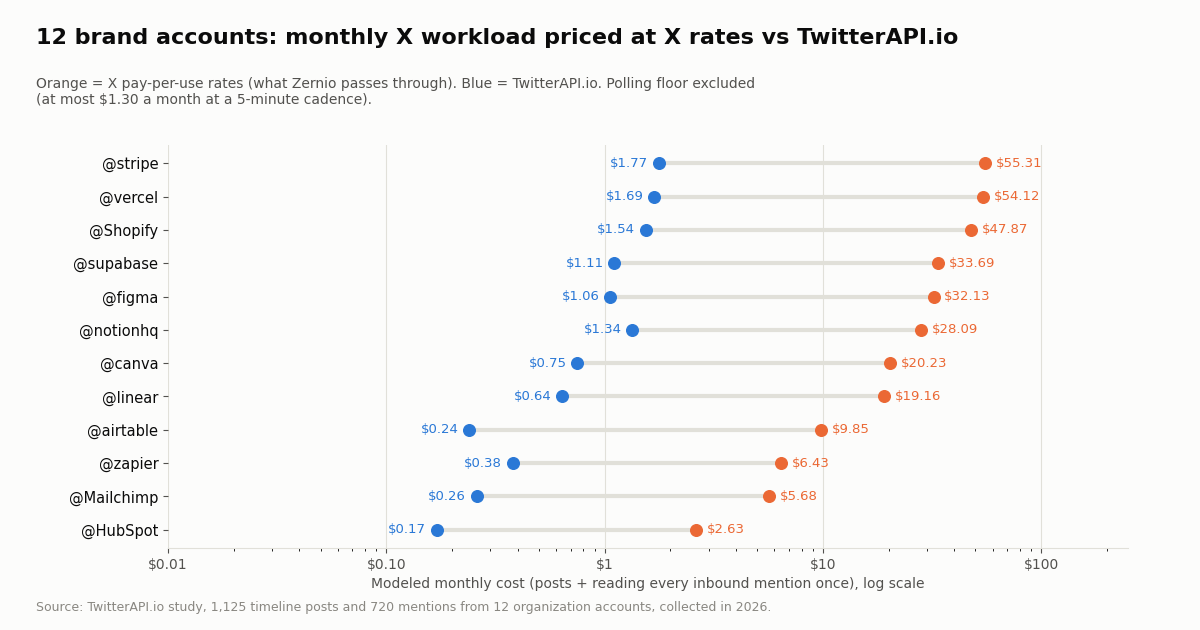
To compare costs on a workload that exists, we measured one. We pulled the recent timelines (including replies) and the most recent inbound mentions of 12 brand and SaaS organization accounts: @notionhq, @figma, @linear, @stripe, @vercel, @supabase, @canva, @Shopify, @HubSpot, @zapier, @airtable and @Mailchimp. That is 1,125 timeline posts and 720 mentions, collected in 2026.
Posting is light. The median account authored 1.46 posts a day (originals, replies and quotes; reposts excluded), which is about 44 a month. 40.4% of everything the brands wrote were replies, so a good share of brand posting is answering people, not broadcasting.
Links are common. 35.8% of the brands' own posts carried an external link (a blog post, a changelog, a docs page). On X's pay-per-use card a post with a URL is $0.200 against $0.015 without, so a link-heavy brand pays mostly for its links: in the median model, 12 link posts a month cost more on X than the other 32 posts combined.
Being mentioned is the big number. The median account drew about 127 mentions a day, or 3,823 a month. Any inbox, listening dashboard or support workflow that reads those mentions has to pull every one of them, and on X's rate card each is a $0.005 post read.
Monthly costs model 30 days of the account's own posts (each priced as a post, at $0.200 when it carried a link) plus reading every inbound mention once. The TwitterAPI.io column prices posts at $0.002 each plus one $0.10 login, and mentions at $0.15 per 1,000; it leaves out the polling floor, which is at most $1.30 a month at a 5-minute cadence.
The median brand, priced both ways
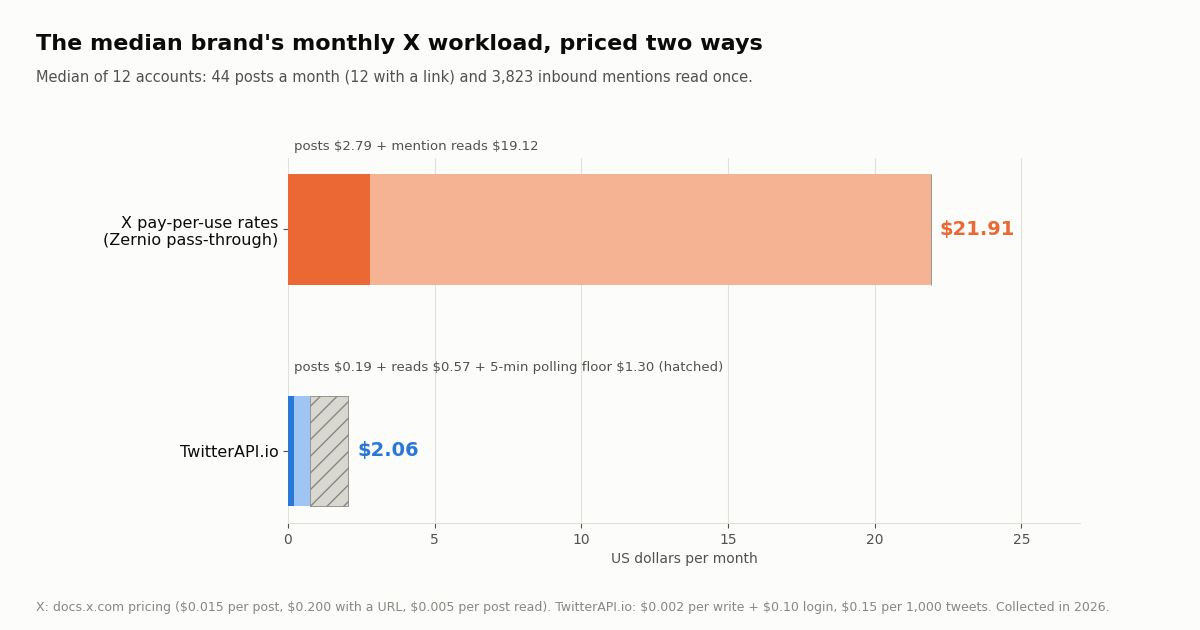
Take the median of the 12 accounts: 44 posts a month, 12 of them with a link, and 3,823 inbound mentions read once each.
Reading drives the bill, not posting. On X's card the mention reads are $19.12 of the $21.91. That is why the choice between a publishing layer and a data API matters most for teams that read: support inboxes, brand monitoring, competitor tracking, research.
The polling floor is honest overhead. TwitterAPI.io bills a minimum of 15 credits ($0.00015) per request, so a check that finds nothing still costs that minimum. Checking every 5 minutes for a month is 8,640 checks, at most $1.30; every 60 seconds is 43,200 checks, $6.48. We include it in the total so the comparison is not flattering by omission.
Zernio's account fee is not in either column. A single-brand X setup sits inside Zernio's two free accounts, so the X pass-through is the whole Zernio bill for this workload. Teams that also connect other networks would add Zernio's account fee on top.
Larger read jobs: where the gap widens
Brand inboxes are small read jobs. Research, listening and data products are not, and there the per-1,000 rate is the whole story.
The ratio is constant: $5.00 against $0.15 per 1,000, about 33x. X's pay-per-use plan is also capped at 3 million post reads per monthly billing cycle; above that X requires an Enterprise plan. On TwitterAPI.io, throughput is set by the rate limit: 20 requests per second once you have paid (0.2 before the first payment), 50 on Scale, 500 on Business and up to 1,000 on request.
X's 24-hour deduplication helps only for repeats. X does not charge again for a resource it already billed you for within the same UTC day (a soft guarantee per its docs). A listening job that reads each new tweet once gets no benefit from it.
Posting to X without the $0.200 link fee
TwitterAPI.io is a data API first, but writes are a product too. They run through an authenticated session: one /twitter/user_login_v2 login ($0.10, with a proxy you supply) returns login_cookies, and each post, delete, like, retweet, follow or unfollow is then one call at $0.002, link or no link.
What comes with that. The call acts as that X account, so X's rules apply and X can rate-limit, lock or suspend the account; keep a human pace. The session can stop working and need a new login. Billing is per HTTP 200 call, which includes some refusals from X that come back as HTTP 200 with status: error. Reads are different: they need only an API key and no X account.
When Zernio is still the better fit for posting. If the same post must go to X, Instagram, TikTok and LinkedIn in one call, with one approval flow and one inbox, Zernio's multi-network publishing is the reason to use it, and an X-only API does not replace that.
import os

import requests

BASE = "https://api.twitterapi.io"
H = {"X-API-Key": os.environ["TWITTERAPI_IO_API_KEY"]}
PROXY = os.environ["X_PROXY"]          # a proxy you supply, used on login and every write

# 1) One login ($0.10). Store login_cookies and reuse them; do not log in per post.
r = requests.post(f"{BASE}/twitter/user_login_v2", headers=H, timeout=90, json={
    "user_name": os.environ["X_USER"], "email": os.environ["X_EMAIL"],
    "password": os.environ["X_PASSWORD"], "proxy": PROXY,
    "totp_secret": os.environ.get("X_TOTP_SECRET", ""),
})
login_cookies = r.json()["login_cookies"]

# 2) Each post is one call ($0.002, billed per HTTP 200 call), with or without a link.
r = requests.post(f"{BASE}/twitter/create_tweet_v2", headers=H, timeout=90, json={
    "login_cookies": login_cookies, "proxy": PROXY,
    "tweet_text": "Our changelog for this week: https://example.com/changelog",
})
body = r.json()
print(body.get("status"), body.get("tweet_id") or body.get("message"))
Reading mentions and searches with TwitterAPI.io
The read side needs no X account and no OAuth: an API key in the X-API-Key header. /twitter/user/mentions returns mentions of any handle (20 per page, with sinceTime and untilTime in Unix seconds), /twitter/tweet/advanced_search takes X search operators with queryType=Latest or Top, and /twitter/user/last_tweets returns an account's timeline. Each follows has_next_page and next_cursor, and each bills 15 credits per tweet returned ($0.15 per 1,000).
A 5-minute mention poller for one brand, using the median account from the study, reads about 3,800 mentions a month and costs well under a dollar in tweets plus at most $1.30 in empty checks.
Push instead of poll. For a fixed list of accounts or keywords, TwitterAPI.io's webhook filter rules push matching tweets to an endpoint you host, so you are not paying for empty checks at all; the docs at docs.twitterapi.io cover the rule endpoints.
import os
import time

import requests

BASE = "https://api.twitterapi.io"
H = {"X-API-Key": os.environ["TWITTERAPI_IO_API_KEY"]}


def new_mentions(user, since_unix):
    """Every mention since a timestamp. Billed 15 credits per tweet returned; an empty
    check costs the 15-credit minimum ($0.00015)."""
    cursor, out = "", []
    while True:
        r = requests.get(f"{BASE}/twitter/user/mentions", headers=H, timeout=30,
                         params={"userName": user, "sinceTime": since_unix, "cursor": cursor})
        r.raise_for_status()
        body = r.json()
        out += body.get("tweets") or []
        if not body.get("has_next_page") or not body.get("next_cursor"):
            return out
        cursor = body["next_cursor"]


since = int(time.time()) - 300
while True:
    batch = new_mentions("yourbrand", since)
    since = int(time.time())
    for t in batch:
        a = t.get("author") or {}
        print(t["createdAt"], a.get("userName"), t.get("likeCount"), t["text"][:80])
    time.sleep(300)                # 5-minute cadence: at most $1.30 a month in empty checks
How we collected this
Question. What monthly X workload does a typical brand account generate (own posts, links, inbound mentions), and what does it cost at X's pay-per-use rates, which Zernio passes through, versus TwitterAPI.io?
Accounts. 12 public organization accounts: @notionhq, @figma, @linear, @stripe, @vercel, @supabase, @canva, @Shopify, @HubSpot, @zapier, @airtable and @Mailchimp.
Method and window. For each account, /twitter/user/info, up to 5 pages of /twitter/user/last_tweets with replies, and up to 3 pages of /twitter/user/mentions, collected in 2026. Each account's window is the span its pages cover, from about a week for busy accounts to much longer for quiet ones; a pinned post is dropped. Rates are per day over that span, scaled to 30 days. 106 requests and about 1,845 tweets in total, about $0.28 of API credit.
What the sample cannot show. Mention rates come from the most recent 60 mentions, so a busy account's rate reflects a few hours and can swing with news; the sample says nothing about seasonality, launches or crises. "Has a link" is an external URL in the post's entities, which approximates but may not match exactly how X classifies a post with a URL. Reposts are excluded from the post count. The model reads each mention once; real tools may also read replies, quotes or analytics, which add cost at the same rates.
Privacy. Aggregates only. The organization timelines are stored; mention pages, whose authors are private individuals, were kept only for counting and are not published. No TwitterAPI.io customer data was used.
"""zernio_vs_twitterapi.py - measure YOUR brand's X workload, then price it two ways.

    pip install requests
    export TWITTERAPI_IO_API_KEY=...
    python zernio_vs_twitterapi.py yourbrand

Reads only: no X account and no login are needed. Cost of one run is about
(posts + mentions returned) x $0.00015, e.g. 100 posts + 60 mentions = $0.024.
"""
import os
import sys
import time
from datetime import datetime

import requests

BASE = "https://api.twitterapi.io"
H = {"X-API-Key": os.environ["TWITTERAPI_IO_API_KEY"]}

# Official X API pay-per-use rate card (docs.x.com/x-api/getting-started/pricing),
# which Zernio says it passes through at exact rates with zero markup.
X_POST_READ, X_POST, X_POST_URL = 0.005, 0.015, 0.200
# TwitterAPI.io: 15 credits per tweet returned; $0.002 per write after a $0.10 login.
TA_TWEET, TA_WRITE, TA_LOGIN = 0.00015, 0.002, 0.10


def ts(s):
    return datetime.strptime(s, "%a %b %d %H:%M:%S %z %Y")


def own_posts(user, pages=5):
    """Newest-first timeline incl. replies. Shape: data.tweets[], has_next_page, next_cursor."""
    out, cursor = [], ""
    for _ in range(pages):
        r = requests.get(f"{BASE}/twitter/user/last_tweets", headers=H, timeout=30,
                         params={"userName": user, "includeReplies": "true", "cursor": cursor})
        r.raise_for_status()
        body = r.json()
        out += (body.get("data") or {}).get("tweets") or []
        if not body.get("has_next_page") or not body.get("next_cursor"):
            break
        cursor = body["next_cursor"]
        time.sleep(0.3)
    if len(out) > 1 and ts(out[0]["createdAt"]) < ts(out[1]["createdAt"]):
        out = out[1:]                      # pinned post sits on top
    return out


def mentions(user, pages=3):
    """Shape: top-level tweets[], has_next_page, next_cursor (20 per page)."""
    out, cursor = [], ""
    for _ in range(pages):
        r = requests.get(f"{BASE}/twitter/user/mentions", headers=H, timeout=30,
                         params={"userName": user, "cursor": cursor})
        r.raise_for_status()
        body = r.json()
        out += body.get("tweets") or []
        if not body.get("has_next_page") or not body.get("next_cursor"):
            break
        cursor = body["next_cursor"]
        time.sleep(0.3)
    return out


def per_day(items):
    if len(items) < 2:
        return 0.0
    t = sorted(ts(x["createdAt"]) for x in items)
    days = max((t[-1] - t[0]).total_seconds() / 86400, 1 / 24)
    return len(items) / days


def has_link(t):
    for u in (t.get("entities") or {}).get("urls") or []:
        exp = (u.get("expanded_url") or "").lower()
        if "twitter.com/" not in exp and "//x.com/" not in exp:
            return True
    return False


def main(user):
    posts = [t for t in own_posts(user) if not t.get("retweeted_tweet")]
    ment = mentions(user)
    posts_month = per_day(posts) * 30
    link_share = sum(has_link(t) for t in posts) / len(posts) if posts else 0
    url_month = posts_month * link_share
    ment_month = per_day(ment) * 30

    x_cost = (posts_month - url_month) * X_POST + url_month * X_POST_URL + ment_month * X_POST_READ
    ta_cost = posts_month * TA_WRITE + TA_LOGIN + ment_month * TA_TWEET
    print(f"@{user}: {posts_month:.0f} posts/month ({url_month:.0f} with a link), "
          f"{ment_month:,.0f} mentions/month")
    print(f"  at X pay-per-use rates : ${x_cost:,.2f}/month")
    print(f"  at TwitterAPI.io rates : ${ta_cost:,.2f}/month (+ at most $1.30 polling floor at 5 min)")


if __name__ == "__main__":
    main(sys.argv[1] if len(sys.argv) > 1 else "vercel")
Questions readers ask
What is Zernio?
Zernio is a unified social media API: one API key and one create-post call to publish or schedule posts across many networks, plus inboxes for DMs and comments, ads, phone numbers and webhooks. On X it acts through an X account you connect and the official X API.
Is Zernio the same as Late (getlate.dev)?
Yes. Zernio's rebrand notice at my.zernio.com/rebrand says Late is now Zernio with the same API, team and infrastructure. getlate.dev redirects to zernio.com, the base URL is now https://zernio.com/api/v1, the SDKs are @zernio/node and zernio-sdk, and LATE_API_KEY became ZERNIO_API_KEY. Old names keep working during a grace period.
How much does Zernio cost?
Per connected account: the first 2 free, accounts 3-10 at $6 each a month, 11-100 at $3, and 101 and up at $1. Messages beyond 10,000 a month are $1 per 10,000. X API calls are extra, passed through at X's rates with zero markup: $0.005 per read, $0.010 per user read or follow, $0.015 per post or DM, $0.200 per post with a URL.
Why does Zernio charge separately for X?
X sells API access per call on its pay-per-use plan. Zernio's FAQ says it passes X's exact rates through with zero markup, and that X analytics and inbox sync are opt-in so you control the cost. The result is that Zernio's X bill equals what X would charge you directly.
Can Zernio search tweets?
Yes, recent search only: Zernio's search-tweets endpoint covers public tweets from the last 7 days, requires a connected X account, takes X's search operators, and allows 300 requests per 15 minutes per connected account. Results are billed at X's read rate.
Is there a lower-cost way to read X data than X pass-through rates?
TwitterAPI.io bills $0.15 per 1,000 tweets returned, against $5.00 per 1,000 post reads on X's pay-per-use card, about 33x less, and reads need no X account. In our 12-brand study the median monthly workload cost about $22 at X rates and about $2 on TwitterAPI.io, including a 5-minute polling floor.
Can I post to X with TwitterAPI.io instead of Zernio?
Yes, for X only. After one /twitter/user_login_v2 login ($0.10, with a proxy you supply), each /twitter/create_tweet_v2 call is $0.002, with or without a link. The call acts as that X account, so X can rate-limit, lock or suspend it; keep a human pace, and expect the session to need re-login at times. Billing is per HTTP 200 call.
When should I stay with Zernio?
When one post must go to several networks at once, or you want one inbox across Instagram, Facebook, WhatsApp and X. TwitterAPI.io is X-only, so it fits as the X data layer next to a multi-network publisher, or on its own for X-focused products.
Continue
- X developer docs: pay-per-use pricing (per-resource reads, per-request writes, $0.200 URL posts, 3M post-read cap, 24h dedup)
- TwitterAPI.io docs: introduction, authentication and pricing model
- TwitterAPI.io docs: get user mentions (sinceTime, untilTime, cursor)
- TwitterAPI.io docs: get user last tweets (includeReplies, pagination)
- TwitterAPI.io docs: advanced search (query operators, queryType)
- TwitterAPI.io docs: create tweet v2 (login_cookies, proxy)
- X API hub: endpoints, pricing and guides
- Twitter (X) auto post: scheduling, RSS and posting from code
- Upload-Post alternative for X posting and data
- X API cost breakdown: what pay-per-use really costs
- TwitterAPI.io vs the official X API, side by side
- How to search mentions on Twitter (X)
- Twitter (X) scheduler options compared
- TwitterAPI.io pricing: $0.15 per 1,000 tweets
- 01TweetGrok Twitter (X) Viewer: What It Is, Whether It Works, and Safer Options
- 02Is X.com (Twitter) Down Right Now, or Is It Just You?
- 03Brandwatch API Explained: Consumer Research vs Engage, Access, and What You Get for Twitter (X)
- 04A Meltwater Alternative for Teams That Mainly Need X (Twitter) Mentions
- 05Sprout Social API in 2026: What It Returns, What It Costs, and Where Twitter (X) Data Runs Out
- 06Syften Alternative for Twitter (X) Keyword Alerts: The $40 Add-On vs Pay-Per-Tweet
- 07Upload-Post Alternative for Twitter (X): Post, Read and Search From One API
- 08Topsy Twitter Analytics Alternative — What Replaced It in 2026?
Stop reading. Start building.
Starter credits cover real testing on real data. Google sign-in, no card, no application queue.
Get an API key