Syften Alternative for Twitter (X) Keyword Alerts: The $40 Add-On vs Pay-Per-Tweet
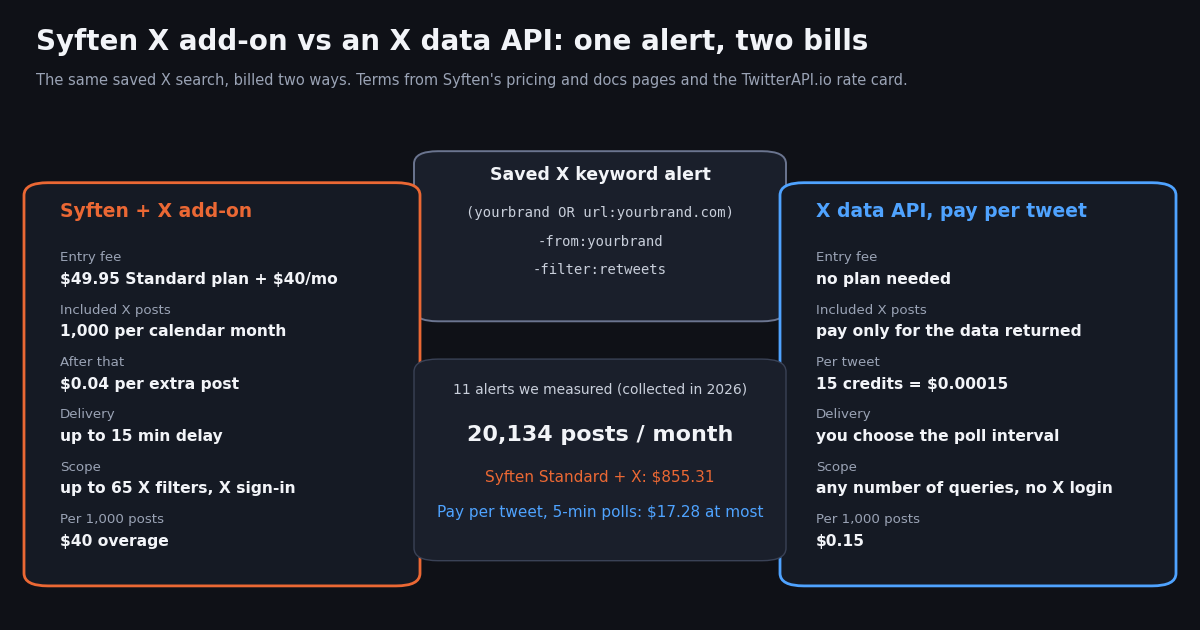
This page is about one product decision: whether to pay for Syften's X (Twitter) monitoring add-on or run the same X keyword alerts on an X data API. If you want the general picture of monitoring accounts and keywords on X, read our Twitter monitoring guide; if you want to build a keyword alert pipeline from scratch (poll, dedupe, score, deliver), the Twitter alerts for keywords developer guide covers the architecture. Here we take Syften's own published plans and X add-on terms, measure what typical founder alerts actually match on X, and price both options at those volumes.
Syften (syften.com) is a keyword monitoring service operating since 2019 that watches Reddit, Hacker News, Indie Hackers, GitHub, Stack Exchange, Slack communities, podcasts, Bluesky, Mastodon, YouTube, the public web and X. Its customer quotes describe founders using it to catch untagged mentions and buying-intent threads. For every source except X and YouTube, the plan price covers it. X is different: Syften's documentation says X monitoring is "completely separate from the other communities", a paid add-on with its own allowance, its own query syntax and an X sign-in. That separation is exactly why an X-only buyer has a cleaner comparison to make.
All Syften facts below were read from syften.com/pricing, syften.com/twitter-mentions and syften.com/documentation this session. All X volumes come from our own study of 11 saved searches on live X data, collected in 2026, with the method at the end of the page.
Syften pricing and the X add-on, as published
Syften sells three monthly plans. The plan decides how many community and web filters you get, how many results a day it delivers, how far back archive search goes, and which delivery integrations are available. X and YouTube are not part of any plan; they are add-ons, and only on Standard and PRO.
What the X add-on includes. The documentation's implementation notes are precise: "X monitoring is a $40/month add-on for Standard and PRO plans. It allows up to 65 filters and includes 1,000 tweets per calendar month." A daily soft quota stops one busy day from eating the month, and you can authorize monthly overage at $0.04 per additional tweet under Setup, Twitter, Quotas. You enable it by signing in with an X account.
What counts against the 1,000. Syften states that "AI-rejected posts still count toward the allowance." Its AI filtering hides noisy matches from your inbox, but those matches were still fetched and still use up tweets. A noisy brand term burns allowance whether or not you ever see the posts.
Delivery speed. X alerts are "available with an up to 15-minute delay" (FAQ and the X monitoring page). Reddit, by comparison, targets under one minute. Delivery goes to email, Slack, RSS, Zapier, the Syften API, or webhooks (webhooks and MCP are PRO features).
Syntax limits on X. Syften uses X API-style search syntax with a few substitutions, and lists what it does not support: cashtags (such as $BTC) and the min_replies, min_faves and min_retweets operators.
The entry price for X alerts is therefore Standard plus the add-on: $49.95 + $40 = $89.95 a month, for at most 1,000 matched tweets before overage. There is a 14-day free trial on the PRO plan, no card required.
What 11 real founder alerts match on X
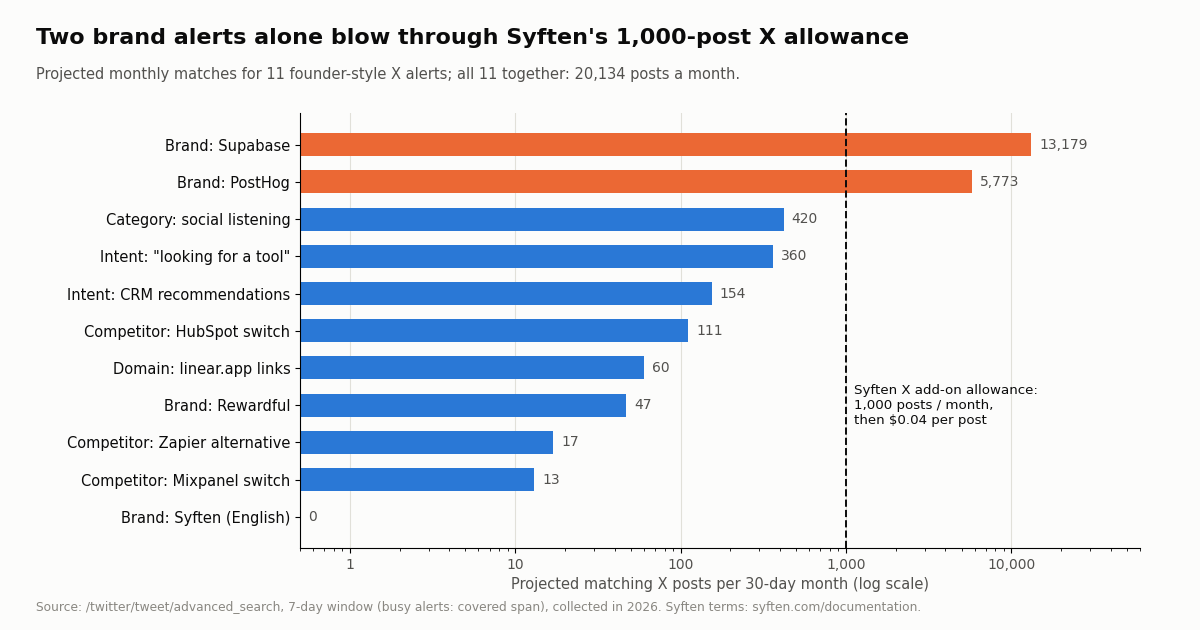
A 1,000-tweet monthly allowance sounds generous until you measure what a brand name matches. We built the kind of alert set a SaaS founder would save in Syften: two brand alerts for well-known developer tools (PostHog, Supabase), one for a smaller SaaS (Rewardful), Syften's own name, three competitor-switch alerts (Mixpanel, HubSpot, Zapier), two buying-intent phrase alerts, a category alert (social listening) and a domain-link alert (url:linear.app). Each ran as an X search over the previous 7 days, with retweets and the company's own posts excluded, the same shape as the examples on Syften's X monitoring page.
Two brand alerts carry the volume. Supabase matched about 439.3 posts a day (13,179 a month) and PostHog about 192.4 a day (5,773 a month). At those rates the Supabase alert alone would use Syften's 1,000-tweet allowance in 2.3 days and PostHog in 5.2 days. A developer tool with an active community is not an edge case; it is the customer Syften's testimonials describe.
The quiet alerts still add up. The other nine alerts were each under 1,000 a month, but together they matched about 1,182 posts, so even a set with no busy brand name crosses the allowance and starts paying $0.04 per tweet.
Most brand matches are replies. 77.1% of PostHog matches and 66.8% of Supabase matches were replies inside threads, much of it support chatter and people tagging the account. Under a per-tweet allowance every one of those counts, read or not. With your own API calls you can add -filter:replies to the brand alert, or route replies to a different channel, and pay only for the data returned.
Buying intent is a minority even on brand alerts. On our fixed keyword rule (a question mark, recommend, alternative, looking for, switching from or to, vs), 22.5% of PostHog and 15.0% of Supabase matches looked like questions or comparisons; on the HubSpot switch alert it was 38.5%. The intent-phrase alerts score 100% by construction, since the phrase is in the query. The useful conclusion: dedicated intent alerts are cheap and focused, brand alerts are where the volume and the allowance go.
Freshness. The newest PostHog match was 3.4 minutes old when the search ran and the newest Supabase match 5.5 minutes old, so for busy queries the search was at most a few minutes behind real time. On quiet alerts the newest match is simply the last post that existed, hours or days old.
Syften's own name. Excluding Swedish-language posts (Syften's documentation notes "syften" is a Swedish dictionary word), the English X search for syften OR url:syften.com returned no posts at all in the 7-day window. A product with no X conversation needs no X budget.
The monthly bill at measured volumes
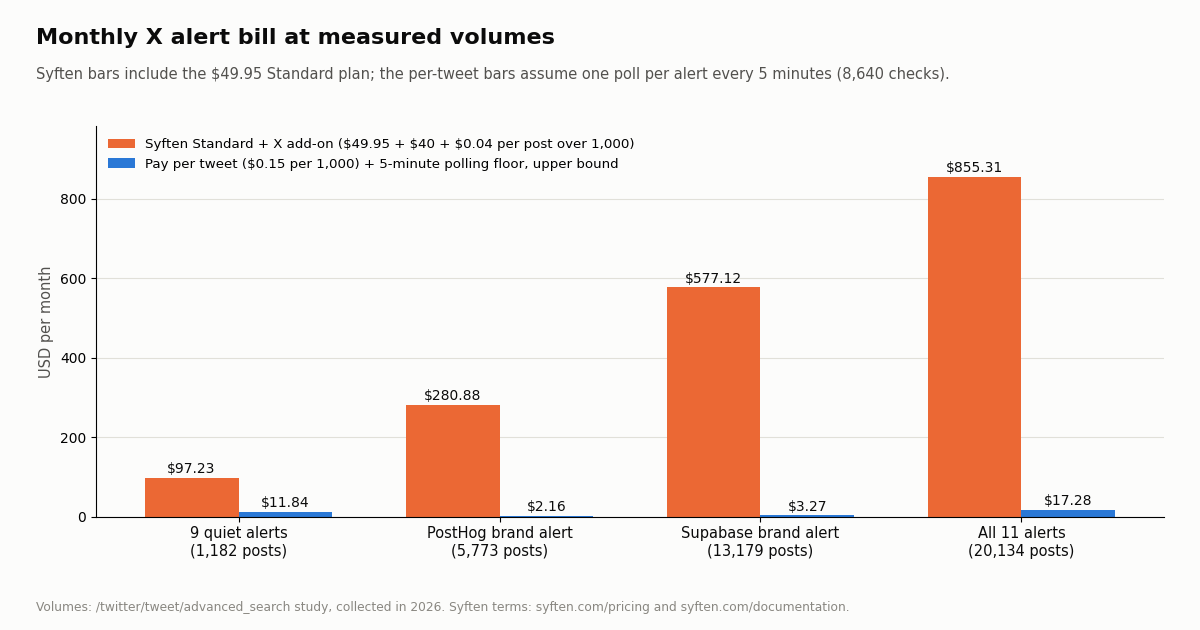
With volumes measured, both bills follow from published terms. Syften: $49.95 Standard plus $40 add-on, plus $0.04 for every tweet above 1,000 in the month (we assume overage is authorized; without it, alerts stop at the quota). TwitterAPI.io: 15 credits per tweet returned ($0.00015) on /twitter/tweet/advanced_search, plus the 15-credit minimum for each poll that finds nothing. For the upper bound we charge every alert a full month of 5-minute polls at the minimum (8,640 checks, $1.30) on top of its tweets.
Read the last row carefully. Of the $17.28, only $3.02 is the tweets themselves; the rest is the floor of polling 11 separate queries every 5 minutes. Combine quiet alerts into one OR query, or poll them every 15 minutes (Syften's own delivery bound), and the floor drops further. On Syften the same row is dominated by overage: 19,134 tweets above the allowance at $0.04 each.
Unit price past the allowance. $0.04 per tweet is $40 per 1,000 tweets. Pay-per-tweet on TwitterAPI.io is $0.15 per 1,000, about 267x less. Even inside the allowance, $40 for 1,000 tweets works out to $0.04 a tweet before the base plan.
Against the official X API. If you build the alerts yourself on X's own pay-per-usage card (docs.x.com/x-api/getting-started/pricing), post reads are $0.005 each, $5 per 1,000, compared with $0.15 per 1,000 here (about 33x). X caps pay-per-usage at 3 million post reads a month, with Enterprise above that, and new paying accounts can earn $20 in credits plus a match of up to $50.
Syften X add-on vs TwitterAPI.io: the comparison matrix
Price is the largest gap, but not the only one. This matrix keeps to what each side publishes or what we tested this session.
Operators we tested. Syften says cashtags and the engagement-threshold operators are not supported on its X add-on. On /twitter/tweet/advanced_search both worked in our run: $NVDA min_faves:50 -filter:retweets returned 20 posts, every one containing the cashtag and the least-liked at 50 likes, and supabase min_replies:3 returned 20 posts with at least 3 replies each. For a founder, min_faves is the cheap noise filter: only alert on brand mentions that already have traction.
Rate limits. TwitterAPI.io allows 0.2 requests per second before the first payment and 20 once paid (50 on Scale, 500 on Business, up to 1,000 on request). A 5-minute poll across a few dozen alerts is far below even the paid default.
Moving your Syften X filters to advanced_search
Syften's X filters use X API-style syntax. TwitterAPI.io's advanced search follows X's web search syntax, which the endpoint docs point to (the igorbrigadir/twitter-advanced-search repository on GitHub). Most terms carry over as typed; a few operators change spelling.
Time window. Add since_time:<unix seconds> to each query so a poll returns only posts newer than your last run. The docs note the since: date format with underscores is not supported; use the Unix timestamp.
Pagination. Results come 20 per page, newest first. Follow next_cursor while has_next_page is true. A busy brand query after a 5-minute gap is usually one page; after an outage of your poller it may be several, and you pay for each tweet once.
Keep Syften's advice on parentheses. Syften warns that OR precedence on X is counterintuitive and recommends wrapping groups: write a (b OR c), not a b OR c. That holds on advanced search too.
One job per query. Syften's guidance to keep brand coverage, buying intent, competitor complaints and your own posts in separate alert streams is good practice on any backend; it is also what lets you poll the busy brand alert more often than the quiet intent alerts.
# Syften X filter (API-style)
(@yourbrand OR "Your Brand" OR yourbrand.com) lang:en -from:yourbrand -is:retweet

# Same alert on /twitter/tweet/advanced_search (web search syntax + time window)
(@yourbrand OR "Your Brand" OR url:yourbrand.com) lang:en -from:yourbrand -filter:retweets since_time:1792640000

# Brand mentions that already have traction (not supported on Syften's X add-on)
("Your Brand" OR url:yourbrand.com) min_faves:10 -filter:retweetsBuild the same alert pipeline in about 60 lines
The script at the bottom of this page reproduces what the Syften X add-on does for a founder: a few saved searches, checked on a schedule, de-duplicated, flagged for intent, and posted to Slack. It keeps a per-alert since_time cursor, follows next_cursor pagination, and remembers seen tweet ids so overlapping windows never double-post.
Fields it reads. Each item in the top-level tweets array carries id, url, text, createdAt, isReply, lang, the engagement counts (likeCount, replyCount, retweetCount, viewCount) and an author object with userName, name and followers. That is enough to route by alert, drop replies from a brand channel, or raise priority for an author with a large following.
Delivery. The script posts to a Slack incoming webhook if SLACK_WEBHOOK_URL is set and prints otherwise. Swap deliver() for email, a CRM insert or a Zapier catch hook; Syften's delivery list (email, Slack, RSS, Zapier, API, webhooks) maps to a function call each.
Push instead of poll. If you would rather not run a scheduler, TwitterAPI.io can evaluate a filter rule for you: /oapi/tweet_filter/add_rule registers the same query with an interval_seconds, and matches are POSTed to the webhook URL on your account. Each evaluation costs at least the 15-credit minimum and each delivered tweet 15 credits, the same economics as polling. Our Twitter webhooks guide walks through it.
Cost guardrails. Because each tweet is billed once when returned, the expensive mistake is a brand query that is too broad. Run a new alert by hand once with queryType=Latest, look at a page, and tighten it (exclude replies, add lang:, add min_faves:) before it goes into the loop.
When Syften is still the right buy
If your market talks on Reddit, Hacker News, Indie Hackers, Stack Exchange, GitHub issues and niche forums, and X is one source among many, Syften remains a fit: those communities are included in the plan, it ships AI qualification and automated onboarding that writes your first filters, and the inbox is already built. TwitterAPI.io covers X only and does not replace that multi-community coverage.
For the X part, the numbers point one way. If X is the main channel, or the X add-on is what pushes your Syften bill past the base plan, moving X alerts to an X data API keeps the rest of your Syften setup intact while removing the 1,000-tweet ceiling, the $0.04 overage and the 15-minute delivery bound. Nothing stops you from running both: Syften for communities, your own advanced search loop for X.
Getting started and what it costs to try
New TwitterAPI.io accounts that pass the automatic bot check get up to $1 of free credits (at most 100,000 credits, no card, one per person or network, expiring after 31 days). At 15 credits per tweet that is up to 6,666 tweets, enough to test every alert in a set like ours several times over: our whole 11-alert study cost about $0.13. Purchased credits ($1 = 100,000 credits) never expire.
If you prefer a fixed monthly line item, subscriptions run Starter $29, Builder $99, Pro $199, Scale $499 and Business $1,499 a month; see the pricing page for what each includes.
Replying from code is a separate product. Alerts only read. If you want to answer a buying-intent post programmatically, write actions run through an authenticated session: one /twitter/user_login_v2 login ($0.10, with a proxy you supply) returns login_cookies, and each post through /twitter/create_tweet_v2 is then $0.002, billed per HTTP 200 call. The call acts as that account, so X can rate-limit, lock or suspend it; keep a human pace, expect occasional re-login, and for buying-intent replies a person usually does better than a script.
How we collected this
Question. How many X posts would a typical founder's Syften-style alert set match per month, how much of it is replies and intent, and what would each option cost at those volumes?
Queries. Eleven saved searches on /twitter/tweet/advanced_search with queryType=Latest: brand alerts for PostHog, Supabase, Rewardful and Syften (each with the brand's domain via url:, excluding the brand's own account and retweets), competitor-switch alerts for Mixpanel, HubSpot and Zapier, two buying-intent phrase alerts, a social listening category alert and a url:linear.app link alert. Exact query strings are in the study's protocol.json.
Window and sample. Each alert covered the 7 days before collection via since_time, up to 9 pages. The two brand alerts that hit the page cap were sampled in a second window 3.5 days earlier and their daily rate computed from the covered span. In total 836 posts across 57 requests, collected in 2026, at a cost of about $0.13. Monthly figures are daily rates times 30.
What the sample cannot show. One week is not a season; launches and outages spike brand volume. Busy brand rates come from about a day and a half of coverage. The intent rule is a keyword heuristic, not a model. We did not run the same filters inside Syften, so we cannot say how many posts its AI filtering would hide, only that Syften counts them toward the allowance anyway.
Privacy. Keyword searches return mostly private individuals, so raw search pages were not kept. The published sample holds de-identified rows only (alert, hour, reply flag, link flag, length bucket, intent flag, language) with no ids, URLs, text or handles. Brand names in queries are public companies.
import os
import re
import time
import requests

BASE = "https://api.twitterapi.io"
HEADERS = {"X-API-Key": os.environ["TWITTERAPI_IO_KEY"]}
SLACK_WEBHOOK = os.environ.get("SLACK_WEBHOOK_URL")  # optional: post matches to Slack

# One saved search per job, the same way Syften asks you to split X filters.
ALERTS = {
    "brand": "(yourbrand OR url:yourbrand.com) -from:yourbrand -filter:retweets",
    "competitor": "competitor (alternative OR expensive OR \"switching from\") -filter:retweets lang:en",
    "intent": "(\"looking for a tool\" OR \"any recommendations\") (crm OR \"help desk\") -filter:retweets lang:en",
}
INTENT = re.compile(r"\?|recommend|alternative|looking for|switch(ing|ed)? (from|to)", re.I)


def search_new(query, since_unix):
    """Every post matching `query` created after `since_unix`, newest first."""
    tweets, cursor = [], ""
    while True:
        resp = requests.get(
            f"{BASE}/twitter/tweet/advanced_search",
            headers=HEADERS,
            params={"query": f"{query} since_time:{since_unix}", "queryType": "Latest", "cursor": cursor},
            timeout=30,
        )
        resp.raise_for_status()
        body = resp.json()
        tweets += body.get("tweets", [])
        if not body.get("has_next_page") or not body.get("next_cursor"):
            return tweets
        cursor = body["next_cursor"]


def deliver(alert, tweet):
    author = (tweet.get("author") or {}).get("userName", "?")
    flag = "INTENT " if INTENT.search(tweet.get("text") or "") else ""
    line = f"[{alert}] {flag}@{author}: {tweet['text'][:280]}\n{tweet['url']}"
    if SLACK_WEBHOOK:
        requests.post(SLACK_WEBHOOK, json={"text": line}, timeout=10)
    else:
        print(line, "\n")


def run(poll_seconds=300):
    last = {name: int(time.time()) - poll_seconds for name in ALERTS}
    seen = set()
    while True:
        for name, query in ALERTS.items():
            started = int(time.time())
            for tweet in reversed(search_new(query, last[name])):  # oldest first
                if tweet["id"] in seen:
                    continue
                seen.add(tweet["id"])
                if tweet.get("isReply") and name == "brand":
                    continue  # optional: keep replies out of the brand channel
                deliver(name, tweet)
            last[name] = started - 60  # small overlap; `seen` drops repeats
        time.sleep(poll_seconds)


if __name__ == "__main__":
    run()
Questions readers ask
How much does Syften cost?
Syften lists Entry at $29.95 a month, Standard at $49.95 and PRO at $119.95 (syften.com/pricing). X monitoring is a $40-a-month add-on available on Standard and PRO only, and YouTube monitoring is a $20 add-on. There is a 14-day free trial on PRO with no card required.
Does Syften monitor Twitter (X)?
Yes, through a paid add-on. It runs separately from Syften's community filters, allows up to 65 X filters, includes 1,000 tweets per calendar month, and delivers alerts with a delay of up to 15 minutes. You enable it by signing in with an X account.
What happens when the Syften X add-on hits 1,000 tweets?
A daily soft quota spreads the allowance over the month, and you can authorize monthly overage at $0.04 per additional tweet. AI-rejected posts still count toward the 1,000. In our study, a Supabase brand alert matched enough posts to use the allowance in a little over two days.
What is a cheaper Syften alternative for X alerts?
For X alone, run the same saved searches on an X data API. On TwitterAPI.io, /twitter/tweet/advanced_search costs 15 credits per tweet returned ($0.15 per 1,000 tweets), with no plan and no X login. For our 11-alert set that was at most $17.28 a month with 5-minute polling, against $855.31 on Syften Standard plus the X add-on.
Can I keep Syften for Reddit and move only X?
Yes. The X add-on is configured separately from Syften's community filters, so dropping it leaves Reddit, Hacker News, forum and web alerts untouched. Point your X filters at your own advanced search loop and send both streams to the same Slack channel.
Do my Syften X filters work on advanced_search?
Mostly as typed. Keywords, quoted phrases, OR groups, from:, to:, lang: and url: carry over. Replace -is:retweet with -filter:retweets, -is:reply with -filter:replies and has:links with filter:links, and add since_time with a Unix timestamp. Cashtags and min_faves, which Syften's X add-on does not support, work on advanced search.
How fast are alerts compared with Syften's 15 minutes?
As fast as you poll. In our study the newest PostHog match was 3.4 minutes old and the newest Supabase match 5.5 minutes old when the search ran. A 5-minute poll costs at least $1.30 a month per alert in empty checks; a 60-second poll at least $6.48.
Continue
- TwitterAPI.io docs: advanced search endpoint (query, queryType, since_time, cursor, 20 per page)
- TwitterAPI.io docs: add filter rule (interval_seconds, webhook delivery)
- X API pricing: pay-per-usage rate card ($0.005 per post read, 3M monthly cap)
- igorbrigadir/twitter-advanced-search: X web search operator reference (filter:, min_faves, url:)
- X API docs: search operators (is:retweet, is:reply, has:links, the API-style syntax Syften filters use)
- Twitter (X) API overview: endpoints, pricing and limits
- Twitter monitoring guide: accounts and keywords
- Twitter (X) keyword alerts: developer guide
- Twitter search operators for the API
- Twitter (X) webhooks and filter rules
- F5Bot alternative for X keyword alerts
- Twilert alternative for Twitter alerts
- TwitterAPI.io pricing and plans
- 01TweetGrok Twitter (X) Viewer: What It Is, Whether It Works, and Safer Options
- 02Is X.com (Twitter) Down Right Now, or Is It Just You?
- 03Brandwatch API Explained: Consumer Research vs Engage, Access, and What You Get for Twitter (X)
- 04A Meltwater Alternative for Teams That Mainly Need X (Twitter) Mentions
- 05Sprout Social API in 2026: What It Returns, What It Costs, and Where Twitter (X) Data Runs Out
- 06Zernio Alternative for Twitter (X) Data: Pricing, API Scope and Real Workload Costs
- 07Upload-Post Alternative for Twitter (X): Post, Read and Search From One API
- 08Topsy Twitter Analytics Alternative — What Replaced It in 2026?
Stop reading. Start building.
Starter credits cover real testing on real data. Google sign-in, no card, no application queue.
Get an API key