Grok 4.7: API model id, pricing, context window, and feeding it Twitter (X) data
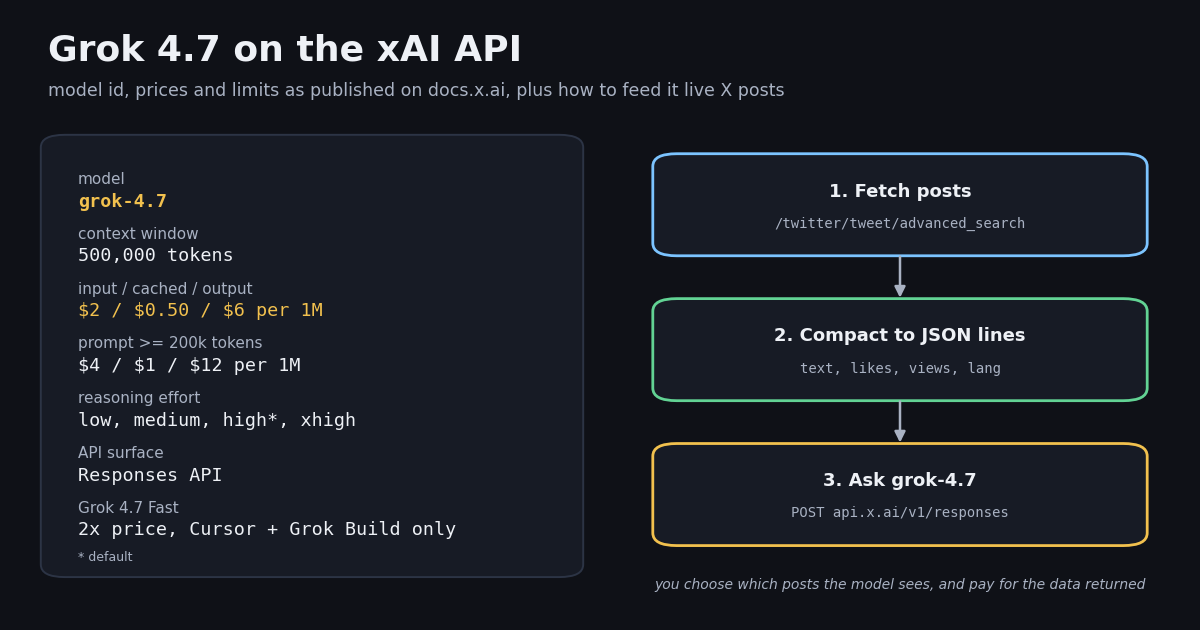
This page is a reference for the model itself: the grok-4.7 id, its token prices and long-context rates, the 500,000-token window, what changed from Grok 4.6, where the Fast variant is sold, and a measured look at how X reacted to the launch. If you need the account side (creating a key on the xAI console, free credits, key errors), read our guide to getting a Grok API key; if you are looking at the hosted agent product that lives on X, read the Grok Bot page. Neither of those covers Grok 4.7's price sheet or its changes from 4.6.
Every fact about the model below was read this session from four xAI pages: the launch post at x.ai/news/grok-4-7, the developer guide at docs.x.ai/developers/grok-4-7, the pricing page at docs.x.ai/developers/pricing and the API release notes. xAI's site now titles its pages SpaceXSI (the footer reads SpaceXAI LLC), but the API host is still api.x.ai and the docs still call it the xAI API, so this page uses both names where they apply.
The second half is about data. Grok 4.7 does not know what happened on X after its training cutoff unless something hands it posts, so we show both ways to do that, what each costs per 1,000 posts, and a runnable Python example that pulls posts through twitterapi.io and asks grok-4.7 to summarize them.
What Grok 4.7 is, according to xAI
xAI's launch post calls Grok 4.7 its most powerful model for coding and knowledge work, and says it "works longer on difficult tasks, checks its own work more carefully, and comes with our best-calibrated safeguards to date." The developer guide describes it in one line as a frontier model built for coding, agentic tasks and knowledge work, and the Models page tells developers to use it for everything except audio, image and video, which have their own dedicated models.
Release. The API release notes list Grok 4.7 on September 21, 2026, the same day as the launch post. Grok 4.6, its predecessor, reached the API on August 12, 2026, and Grok 4.5 on July 8, 2026, so this is the third flagship text model in roughly eleven weeks.
What is new under the hood. Per the launch post, Grok 4.7 uses a new, larger base model than Grok 4.6, trained with a longer reinforcement learning run on a harder mix of tasks weighted toward problems that take many hours to complete. xAI says it is better at verifying its own work and at managing long context, and that it was trained to understand the Grok Bot harness natively, which helps on conversational tasks.
Safety claims. The post says Grok 4.7 ships with a new safeguard stack, scored 62.4% on LatchBio's biosafety benchmark, and let only 3.3% of risky dual-use prompts through on HackerBench v0.3, xAI's own benchmark for malicious cyber tasks. Those are vendor-reported numbers; no independent replication was available when we checked.
Where it runs. The developer guide lists five places: the xAI API (key from the console), a US regional endpoint at https://us.api.x.ai/v1 that keeps inference in the United States at a 10% premium, Grok Build (where it is the default model of the coding agent), Cursor (on all plans), and the model gateways OpenRouter, Vercel and Cloudflare.
Grok 4.7 API: model id, endpoint and spec sheet
The developer guide's "At a glance" table is the authoritative spec sheet. We copied it below exactly as published.
Use the Responses API. Every example in the Grok 4.7 guide calls POST https://api.x.ai/v1/responses with "model": "grok-4.7" and an input field, either a string or a list of role/content messages. The OpenAI SDK works by pointing base_url at https://api.x.ai/v1 and calling client.responses.create; xAI's own xai_sdk and the Vercel AI SDK (xai.responses('grok-4.7')) are the other two documented clients.
Encrypted reasoning is always on. On the Responses API, grok-4.7 returns reasoning.encrypted_content even when your include list does not ask for it. For multi-turn conversations, pass those reasoning items back unchanged in the next request's input and the model keeps its earlier reasoning.
Set a cache key. The guide strongly recommends prompt_cache_key on the Responses API (the x-grok-conv-id header on Chat Completions). It pins a conversation to one server so cached input actually hits; without it, xAI warns, you often pay full input price on a cache-cold server. With cached input at $0.50 against $2.00 fresh, that is a 75% difference on repeated prompt prefixes.
Reasoning effort. The default is high. The xhigh level is what xAI used for its headline benchmark scores, so expect more reasoning tokens (billed as output) when you turn it on.
curl https://api.x.ai/v1/responses \
  -H "Content-Type: application/json" \
  -H "Authorization: Bearer $XAI_API_KEY" \
  -d '{
    "model": "grok-4.7",
    "input": "Find and fix the bug, then explain it: function median(a){a.sort();return a[a.length/2]}"
}'Grok 4.7 pricing, with Grok 4.6 and older models side by side
Grok 4.7 is priced from $2 per million input tokens and $6 per million output tokens, the launch post says, "served at the same price and speed as Grok 4.6." The pricing page adds the detail that matters for long prompts: models with long-context pricing bill every token in a request at the long-context rate once the prompt reaches 200,000 tokens. The table shows short-context rates (input / cached / output) and long-context rates per million tokens, as listed on docs.x.ai/developers/pricing when we read it.
Read the table carefully. Grok 4.7 and Grok 4.6 cost exactly the same. Compared with Grok 4.5, only the cached-input rate went up ($0.30 to $0.50). The older grok-4.3 and grok-4.20 models are cheaper per token and have a larger 1M-token window, which is the main reason to keep them for very long, simple jobs.
Batch API. grok-4.7 gets a 20% discount on all token types (input, output, cached and reasoning) through the Batch API, with most batches finishing within 24 hours. That puts a batch request at $1.60 / $0.40 / $4.80 per million tokens under 200k prompt tokens.
Priority processing. Setting service_tier: "priority" doubles every token rate in exchange for higher scheduling priority. You are only billed the priority rate when the response confirms "service_tier": "priority".
US regional endpoint. Requests to https://us.api.x.ai/v1 bill at 1.1x: for grok-4.7 that is $2.20 / $0.55 / $6.60 per million tokens below 200k prompt tokens and $4.40 / $1.10 / $13.20 above. Only grok-4.7 and grok-4.6 are served there.
Tools cost extra. Server-side tools bill tokens plus invocations: web_search and code_execution are $5 per 1,000 calls, and x_search is billed per item fetched, $5 per 1,000 posts and $10 per 1,000 profiles. A request flagged for a usage-guideline violation before generation carries a $0.05 fee.
Grok 4.7 vs Grok 4.6: what changed and what did not
The short version: same price, same context window, same modalities and reasoning settings, a bigger base model and better scores. The release notes for the two models are almost word for word identical apart from the name: both list a 500k context window, text and image input with text-only output, no text output limit, $2 / $0.50 / $6 below 200k prompt tokens, and reasoning effort of low, medium, high (default) and xhigh. Two things are new for 4.7: the always-on encrypted reasoning on the Responses API, and the Grok 4.7 Fast variant.
The launch post publishes a benchmark table comparing Grok 4.7 at xhigh effort with Grok 4.6 at high effort. We reproduce the Grok rows only; the post also lists two models from other vendors.
Caveat on the comparison. The two columns are not run at the same effort: xAI scored Grok 4.7 at xhigh and Grok 4.6 at high, and the DeepSWE figure for 4.7 is marked high effort. Part of the gap may come from the extra reasoning budget, which you pay for as output tokens. If you are migrating, rerun your own evaluation at the effort level you plan to ship.
Migrating from 4.6. Because the request shape and price are unchanged, switching is a one-string change from grok-4.6 to grok-4.7. The one behavior to plan for is the encrypted reasoning items that now always come back on the Responses API: if your code rebuilds conversation history by hand, keep those items in the next input rather than dropping them.
Grok 4.7 Fast and Grok 4.7 in Cursor
Grok 4.7 Fast is not a separate model. The developer guide describes it as "the same model served on faster infrastructure", and the launch post says it delivers twice the output speed at twice the price. It costs 2x the standard token rates, or 1.5x for long-context requests:
You cannot call it from the API. The pricing page and the guide both state that Grok 4.7 Fast is available only in Cursor and Grok Build, billed through your plan there, not on the public xAI API, and not included in Grok Build's free tier. If you search for a grok-4.7-fast model id, there is none to find on the xAI API.
Cursor. The launch post says Grok 4.7 was available in Cursor on launch day, and the developer guide says it is available on all Cursor plans. Cursor bills its own fast variant through your Cursor plan. xAI chose Cursor's CursorBench 4.0 as its headline coding benchmark and says Grok 4.7 sits "at the frontier in price-performance" on it.
Grok Build. Grok 4.7 is the default model of Grok Build, xAI's coding agent (installed with curl -fsSL https://x.ai/cli/install.sh | bash). The launch post links Grok Build as the place to try the model for free; the Fast variant is not part of that free tier.
How X reacted to the Grok 4.7 launch: what we measured
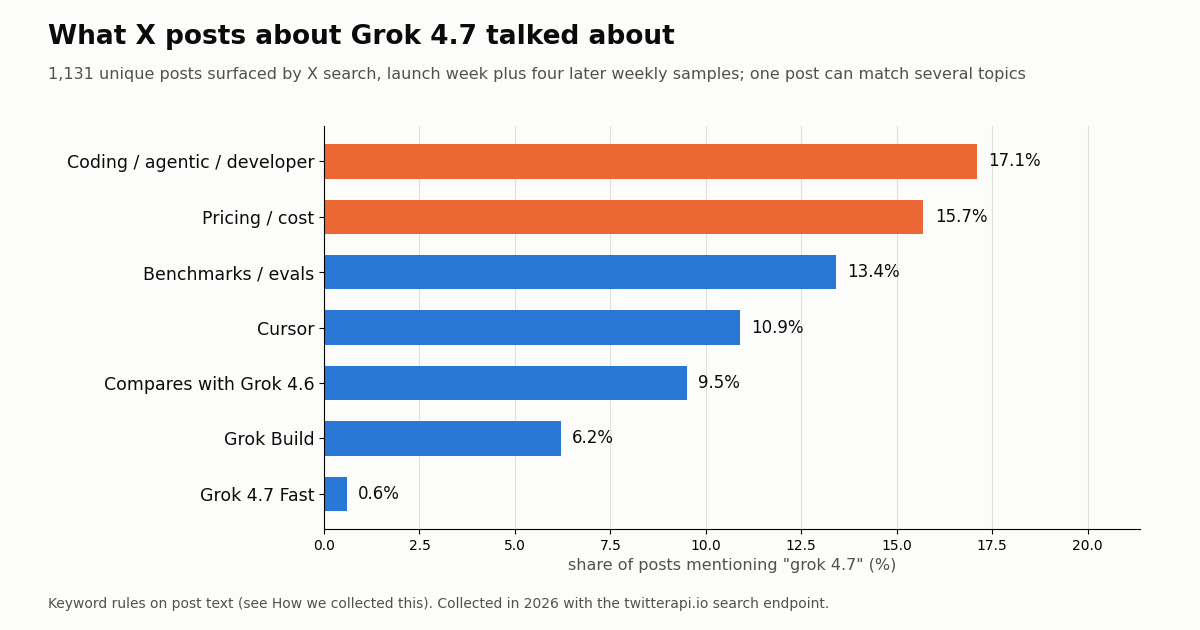
We pulled public posts that mention "grok 4.7" through the twitterapi.io search endpoint: each day of the launch week (one day before launch to six days after) with both the Latest and Top orderings, plus the newest 120 posts from each of the four following weeks. After merging by post id that gave 1,131 unique posts. We also pulled the official @SpaceXSI posts from the launch week. Collected in 2026.
What people talked about. Coding was the most common theme (17.1% of posts), ahead of price (15.7%) and benchmarks (13.4%). Cursor came up in 10.9% of posts, comparisons with Grok 4.6 in 9.5%, Grok Build in 6.2%. Grok 4.7 Fast barely registered at 0.6%, which fits its availability: you can only use it inside Cursor or Grok Build.
Who was talking. 82.4% of the posts were in English, 8.0% in Chinese and 4.0% in Japanese. 13.3% were replies rather than standalone posts. The median post drew 29 likes and 2,767 views; the top 10% drew at least 641 likes and 79,661 views, and 9.9% got no likes at all.
The day before. X search already surfaced 73 posts naming Grok 4.7 on September 20 (UTC), the day before xAI's announcement, so the name was public ahead of the launch post.
The official launch thread, in numbers
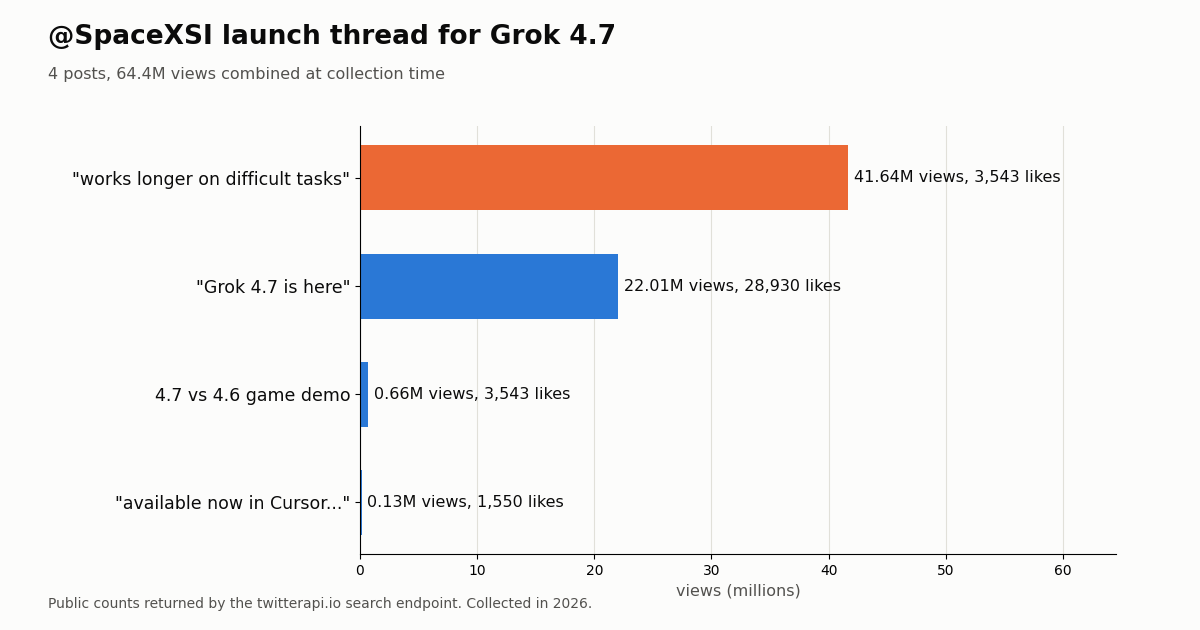
@SpaceXSI announced Grok 4.7 in a four-post thread on September 21, 2026, and posted nothing else in the launch week window we searched. Together the four posts had 64.4M views when we collected them.
Views and likes did not move together. The "works longer on difficult tasks" post drew the most views (41.6M) but about an eighth of the main post's likes. The main post had 28,930 likes, 3,144 reposts and 1,939 quote posts. The post that told developers where to use the model (Cursor, Grok Build, the API) had the smallest reach, 132,011 views.
What this tells a developer. Launch-day attention was concentrated on the official thread, but the follow-on discussion was technical: coding quality, price and benchmark comparisons, in that order. If you track a model launch like this one for your own product, those are the threads worth classifying.
Giving Grok 4.7 live X data: x_search vs fetching posts yourself (with code)
xAI's Models page is direct about it: Grok "has no knowledge of current events or data beyond what was present in its training data", and real-time data needs a server-side search tool. With a May 2026 knowledge cutoff, Grok 4.7 knows nothing about its own launch week. There are two ways to give it X posts.
Route A: the x_search tool. Add {"type": "x_search"} to the request's tools and the model decides what to search for, with optional allowed_x_handles or excluded_x_handles (up to 20) and from_date / to_date filters. It is billed per item fetched: $5 per 1,000 posts, including parent and quoted posts pulled into a thread, and $10 per 1,000 profiles, plus the tokens those posts add to the prompt. Because the model chooses the searches, you do not control how many posts a question fetches.
Route B: fetch the posts, then call the model. Query X through a data API, keep the fields you need, and pass them in the prompt. You decide exactly which posts and how many, the same input can be cached or re-run, and the data cost is fixed before the model sees anything.
The arithmetic. At $0.15 per 1,000 tweets against $5 per 1,000 on both xAI's tool and X's pay-per-usage rate card, fetching posts yourself costs about 33 times less per post. Our own study above read 1,449 tweets for about $0.22. The model side of route B is a normal grok-4.7 call: if your compacted posts come to 20,000 input tokens and the answer to 1,000 output tokens, that request costs 20,000 x $2 / 1M + 1,000 x $6 / 1M = $0.046, plus any reasoning tokens, which bill as output.
Keep the prompt short. The median post in our sample was 250 characters and the 90th percentile 1,130 (long-form posts), so truncating text and dropping unused fields matters more than the number of posts. Staying under 200,000 prompt tokens keeps you on the $2 / $6 rate instead of $4 / $12 for the whole request.
The code. The script below is route B end to end. It searches X through /twitter/tweet/advanced_search (20 posts per page, following next_cursor while has_next_page is true), compacts each post into one JSON line, and sends them to grok-4.7 on the Responses API. It reads the model's text from the output items of type message, whose content parts of type output_text carry the answer, and prints the usage object xAI returns so you can see the real token count of your prompt.
Costs for one run. Five pages is at most 100 tweets, $0.015 of twitterapi.io credits. New twitterapi.io accounts that pass the automatic bot check get up to $1 of free credits (at most 100,000 credits, no card, one per person or network, expiring after 31 days); purchased credits never expire. Reads need only an API key, no X account. Before the first payment the key allows 0.2 requests per second, and 20 once paid.
Adapting it. Swap the query for from:<handle> to summarize an account, use /twitter/user/last_tweets for a timeline, or run the fetch on a schedule and pass only new posts. For a recurring digest, cache the system prompt (and set prompt_cache_key) so the fixed part of each request bills at the $0.50 cached rate.
import os
import json
import requests

TWAPI = "https://api.twitterapi.io"
TW_HEADERS = {"X-API-Key": os.environ["TWITTERAPI_IO_KEY"]}
XAI_HEADERS = {
    "Authorization": f"Bearer {os.environ['XAI_API_KEY']}",
    "Content-Type": "application/json",
}


def ask_grok(question, context):
    """xAI Responses API with the model id from docs.x.ai: grok-4.7."""
    payload = {
        "model": "grok-4.7",
        "input": [
            {"role": "system",
             "content": "You analyze X posts. Use only the posts provided. Cite counts."},
            {"role": "user", "content": f"{question}\n\nPosts (JSON lines):\n{context}"},
        ],
    }
    r = requests.post("https://api.x.ai/v1/responses",
                      headers=XAI_HEADERS, json=payload, timeout=600)
    r.raise_for_status()
    body = r.json()
    text = []
    for item in body.get("output", []):
        if item.get("type") == "message":
            for part in item.get("content", []):
                if part.get("type") == "output_text":
                    text.append(part["text"])
    return "\n".join(text), body.get("usage")


def fetch_posts(query, max_pages=5):
    """Search X through twitterapi.io; 20 posts per page, follow next_cursor."""
    posts, cursor = [], None
    for _ in range(max_pages):
        params = {"query": query, "queryType": "Latest"}
        if cursor:
            params["cursor"] = cursor
        r = requests.get(f"{TWAPI}/twitter/tweet/advanced_search",
                         headers=TW_HEADERS, params=params, timeout=30)
        r.raise_for_status()
        body = r.json()
        posts.extend(body.get("tweets", []))
        if not body.get("has_next_page"):
            break
        cursor = body.get("next_cursor")
    return posts


def compact(posts):
    """One short JSON line per post keeps the grok-4.7 prompt small."""
    lines = []
    for t in posts:
        lines.append(json.dumps({
            "when": t["createdAt"],
            "likes": t.get("likeCount", 0),
            "views": t.get("viewCount", 0),
            "lang": t.get("lang"),
            "text": t["text"][:600],
        }, ensure_ascii=False))
    return "\n".join(lines)


if __name__ == "__main__":
    posts = fetch_posts('"grok 4.7" lang:en -filter:retweets', max_pages=5)
    print(f"fetched {len(posts)} posts (about ${len(posts) * 0.00015:.4f} of twitterapi.io credits)")
    answer, usage = ask_grok(
        "What are developers saying about Grok 4.7? Group the posts into themes "
        "(pricing, coding quality, Cursor, comparisons with Grok 4.6) and give the share of each.",
        compact(posts),
    )
    print(answer)
    print("token usage reported by xAI:", usage)
How we collected this
Question. How did public X react to the Grok 4.7 launch, and what did the reaction focus on?
Accounts and queries. The search query "grok 4.7" on twitterapi.io's /twitter/tweet/advanced_search, one UTC day at a time for the launch week (September 20 to 27, 2026) with both Latest and Top orderings, a variant query for grok-4.7 and grok4.7, and the newest 120 posts of each of the next four weeks. Official posts came from the query from:SpaceXSI over the launch week. We confirmed the handles with /twitter/user/info.
Sample. 1,449 tweets returned across 94 requests (about $0.22), 1,131 unique posts after merging and keeping only posts whose text names Grok 4.7. Collected in 2026.
What the sample cannot show. X search returns a subset of matching posts for past windows, so the per-day counts are what search surfaced, not total volume, and should not be read as a trend. Topics are keyword rules on post text (for example, price, cost or per-million phrasing for pricing), so sarcasm and posts that only use images are missed. View counts are as of collection time. Benchmark and safety numbers on this page come from xAI and were not independently tested; we did not run a paid grok-4.7 call for this page, so token counts in the cost example are an assumption, and the script prints the real ones.
Privacy. Aggregates only. Search results from private individuals were analyzed on a local machine and are not published or kept in the repository; the de-identified sample keeps day, language, topic flags and engagement counts, with no ids, handles or text. Only the official @SpaceXSI organization account is named.
import os
import json
import requests

TWAPI = "https://api.twitterapi.io"
TW_HEADERS = {"X-API-Key": os.environ["TWITTERAPI_IO_KEY"]}
XAI_HEADERS = {
    "Authorization": f"Bearer {os.environ['XAI_API_KEY']}",
    "Content-Type": "application/json",
}


def ask_grok(question, context):
    """xAI Responses API with the model id from docs.x.ai: grok-4.7."""
    payload = {
        "model": "grok-4.7",
        "input": [
            {"role": "system",
             "content": "You analyze X posts. Use only the posts provided. Cite counts."},
            {"role": "user", "content": f"{question}\n\nPosts (JSON lines):\n{context}"},
        ],
    }
    r = requests.post("https://api.x.ai/v1/responses",
                      headers=XAI_HEADERS, json=payload, timeout=600)
    r.raise_for_status()
    body = r.json()
    text = []
    for item in body.get("output", []):
        if item.get("type") == "message":
            for part in item.get("content", []):
                if part.get("type") == "output_text":
                    text.append(part["text"])
    return "\n".join(text), body.get("usage")


def fetch_posts(query, max_pages=5):
    """Search X through twitterapi.io; 20 posts per page, follow next_cursor."""
    posts, cursor = [], None
    for _ in range(max_pages):
        params = {"query": query, "queryType": "Latest"}
        if cursor:
            params["cursor"] = cursor
        r = requests.get(f"{TWAPI}/twitter/tweet/advanced_search",
                         headers=TW_HEADERS, params=params, timeout=30)
        r.raise_for_status()
        body = r.json()
        posts.extend(body.get("tweets", []))
        if not body.get("has_next_page"):
            break
        cursor = body.get("next_cursor")
    return posts


def compact(posts):
    """One short JSON line per post keeps the grok-4.7 prompt small."""
    lines = []
    for t in posts:
        lines.append(json.dumps({
            "when": t["createdAt"],
            "likes": t.get("likeCount", 0),
            "views": t.get("viewCount", 0),
            "lang": t.get("lang"),
            "text": t["text"][:600],
        }, ensure_ascii=False))
    return "\n".join(lines)


if __name__ == "__main__":
    posts = fetch_posts('"grok 4.7" lang:en -filter:retweets', max_pages=5)
    print(f"fetched {len(posts)} posts (about ${len(posts) * 0.00015:.4f} of twitterapi.io credits)")
    answer, usage = ask_grok(
        "What are developers saying about Grok 4.7? Group the posts into themes "
        "(pricing, coding quality, Cursor, comparisons with Grok 4.6) and give the share of each.",
        compact(posts),
    )
    print(answer)
    print("token usage reported by xAI:", usage)
Questions readers ask
What is the Grok 4.7 model id on the xAI API?
The model name is grok-4.7. The developer guide's examples send it to POST https://api.x.ai/v1/responses (the Responses API), and the OpenAI SDK works with base_url set to https://api.x.ai/v1.
How much does Grok 4.7 cost?
$2 per million input tokens, $0.50 per million cached input tokens and $6 per million output tokens while the prompt is under 200,000 tokens. At 200,000 prompt tokens or more, every token in that request bills at $4 / $1 / $12. Batch requests get 20% off; priority processing doubles the rates; the US regional endpoint adds 10%.
What is the Grok 4.7 context window?
500,000 tokens, with text and image input, text output and no text output limit. Older grok-4.3 and grok-4.20 models have a 1M-token window at lower per-token prices.
What is the difference between Grok 4.7 and Grok 4.6?
Grok 4.7 uses a new, larger base model and a longer reinforcement learning run. Price, context window, modalities and reasoning settings are the same. xAI reports higher scores on every benchmark it published for the pair, for example 46.3% vs 40.4% on CursorBench 4.0, though 4.7 was scored at xhigh effort and 4.6 at high.
Can I use Grok 4.7 Fast through the API?
No. Grok 4.7 Fast is the same model on faster infrastructure at 2x the token rates (1.5x on long context), and xAI sells it only inside Cursor and Grok Build, billed through your plan there. It is not on the public xAI API and not in Grok Build's free tier.
When was Grok 4.7 released?
xAI announced Grok 4.7 and added it to the API on September 21, 2026, about six weeks after Grok 4.6 reached the API on August 12, 2026.
Is Grok 4.7 available in Cursor?
Yes. The launch post says it was available in Cursor at launch, and the developer guide says it is on all Cursor plans. Grok 4.7 Fast is also sold in Cursor through your Cursor plan.
Can Grok 4.7 read X (Twitter) posts in real time?
Not by itself; its knowledge stops at its May 2026 cutoff. You can enable the x_search tool, billed at $5 per 1,000 posts plus tokens, or fetch posts through a data API such as twitterapi.io ($0.15 per 1,000 tweets returned) and pass them in the prompt, as the script on this page does.
Continue
- xAI (SpaceXSI): Introducing Grok 4.7, launch post with benchmark table and pricing
- xAI docs: Grok 4.7 developer guide (model id, spec sheet, Fast variant, where it runs)
- xAI docs: API pricing (token rates, long context, batch, priority, tools)
- xAI docs: X Search tool parameters and billing
- X developer docs: X API pay-per-usage pricing
- twitterapi.io API documentation (advanced_search, last_tweets)
- Twitter (X) API overview: endpoints, pricing and limits
- How to get a Grok API key on the xAI console
- Grok Bot on X: what it reads and what its X data costs
- Grok Build: install it and connect it to live X data
- Build an AI Twitter (X) bot in Python
- Twitter (X) sentiment analysis in Python
- Grok Bot marketplace explained
- twitterapi.io pricing per tweet and per profile
- 01GetXBot: What the Twitter (X) Video Bot Is, Whether It Is Safe, and Alternatives
- 02The Best Twitter (X) Accounts to Follow, by Topic
- 03What Is xcancel (X Cancel)? The Twitter (X) Nitter Front End, Explained
- 04Twitter (X) Media Viewer: How to Browse an Account's Photos and Videos
- 05AllMyTweets: What It Did, Its Limits, and How to See Every Tweet on Twitter (X)
- 06Grok Bot and the Twitter (X) API: what it can read, what it costs, and how to give it cheaper X data
- 07Grok Bot Marketplace: the templates, which ones read Twitter (X), and how to build on them
- 08How to Get a Grok API Key: Setup, Pricing and Live X Data for the xAI API
Stop reading. Start building.
Starter credits cover real testing on real data. Google sign-in, no card, no application queue.
Get an API key