What Is xcancel (X Cancel)? The Twitter (X) Nitter Front End, Explained
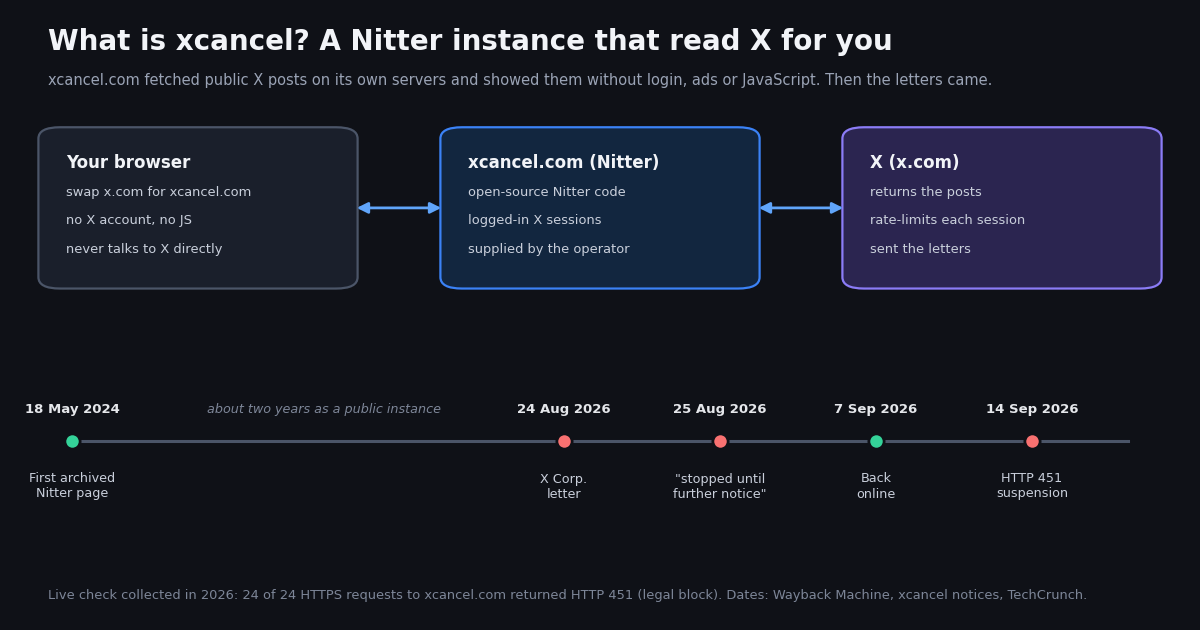
This page answers one question: what xcancel is, how it worked, and what happened to it, with a live status check and a sourced timeline. It is not a list of replacements. If you just want something that works today, our xcancel alternatives guide compares the options we tested, and the Nitter instances page tracks which public instances still answer; both are linked at the end.
xcancel sits in an odd spot in search. People type "x cancel" and "what is xcancel" because the domain shows up in shared links on Reddit, Discord and news comments, usually in place of an x.com link, and since August those links lead to a black page about legal proceedings. Below we explain where the name came from, what the site did with your request, why it shows HTTP 451, what "too many requests" meant when it was still up, whether it was safe, and how it relates to Nitter and nitter.net.
Everything here was checked in 2026: 24 live HTTPS requests to xcancel.com, 703 Wayback Machine captures of its home page going back to May 2024, the Nitter repository and notice, the news coverage of both shutdowns, and 313 posts on X that mention xcancel. We do not link xcancel.com itself; it serves nothing but the notice.
What is xcancel? A Nitter instance with its own name
The short definition. xcancel was a website, xcancel.com, that let anyone read public X (Twitter) posts, profiles, replies and search results without an X account. It did not have its own code: it ran Nitter, the open-source X front end hosted at github.com/zedeus/nitter, which the project describes as "a free and open source alternative Twitter front-end focused on privacy and performance". Many people ran Nitter servers (called instances); xcancel was the best known of them after the flagship nitter.net went offline in 2024.
The name. The oldest working capture of the site in the Wayback Machine is from 18 May 2024, and in May 2024 the page title was "X Cancelled". By 2026 it was styled XCancel. The joke is in the domain: take an x.com link, add "cancel" after the x, and you get xcancel.com/... with the same path, which is exactly how people used it. That is also why "x cancel" and "x cancelled" are searched as the brand.
Who ran it. The About page archived in August 2026 opens with "XCancel is an instance of Nitter" and says that donating to XCancel "helps keep this Nitter instance running" while donating to Nitter funds development, adding that "both projects are run by separate people". The operator did not publish a name on the site, and the news coverage we read does not identify one, so we do not either.
What it was not. xcancel only mirrored X. There was no xcancel for Instagram, TikTok or any other network, and it was never an official X product. It also never showed protected (private) accounts: Nitter can only display what X serves to its own logged-in sessions for public profiles.
How xcancel worked, and what "too many requests" meant
The request path. When you opened xcancel.com/NASA, your browser talked only to xcancel. xcancel's server asked X for the profile and posts, turned the response into a light HTML page and sent it back. Nitter's feature list puts it plainly: "All requests go through the backend, client never talks to Twitter", with "No JavaScript required" and "Zero ads". So X did not see your IP address or run its scripts in your browser; xcancel's operator, on the other hand, did receive your requests.
The accounts behind the curtain. Nitter was built on the anonymous "guest" access X once gave logged-out visitors. X removed that in January 2024 and the project stopped; when development resumed on 6 February 2025, every instance needed real X accounts, with their session tokens loaded on the server (TechCrunch describes it as hosts having to link instances to a real X account). xcancel's readers shared that pool of sessions. That design is what made the site work, and it is also what X's letters later targeted.
RSS and search. Every profile had a feed at /username/rss, which is why "xcancel rss" is still searched: people subscribed to X accounts in feed readers through it. Search worked at /search, which mattered because logged-out x.com sends search to the login page. Both are now behind the same 451; in our check /NASA/rss and /search returned the notice like every other path.
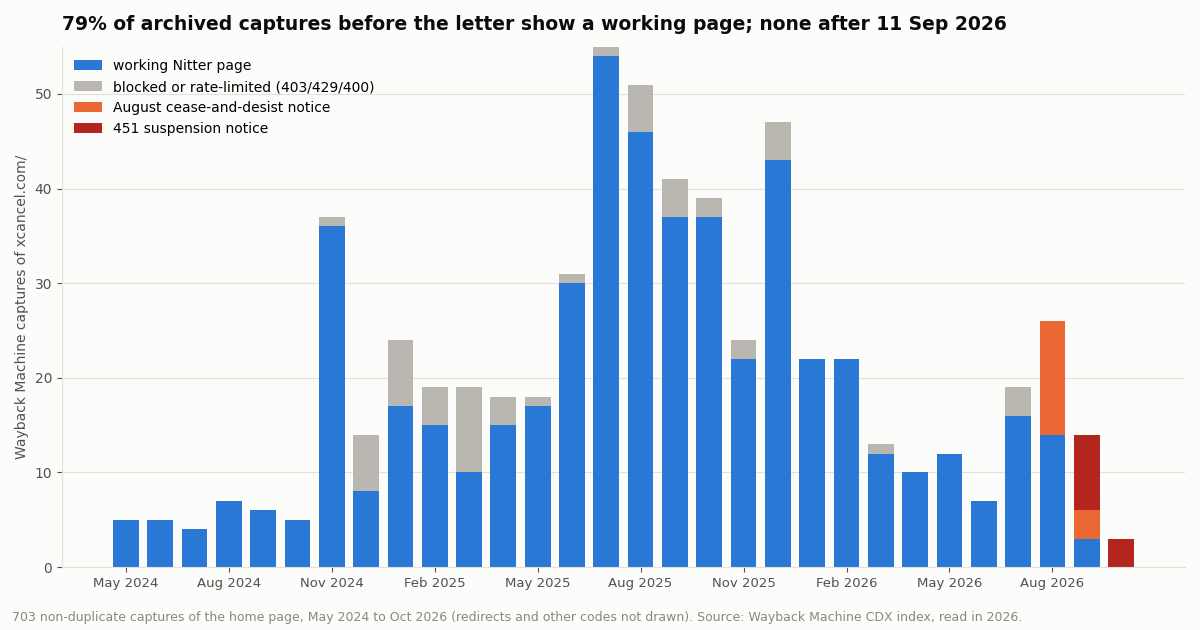
What "too many requests" was. Each X session has its own rate limit, and a busy public instance spreads thousands of readers over a few sessions, so it hits limits no single person would. Instances protect themselves with limits of their own. The Wayback Machine has 13 captures of xcancel pages that returned 429 Too Many Requests (a bare openresty error page), all from January and February 2025: 7 post pages, 4 profile or timeline pages and 2 searches. The home page itself returned 403 Forbidden to 52 of the archive's visits before the letter. A 429 meant "slow down and retry later"; it was never a ban on you personally.
Why 451 is different. HTTP 451, "Unavailable For Legal Reasons", is the status code RFC 7725 defines for use "when resource access is denied as a consequence of legal demands". Unlike a 429, retrying, switching browsers or waiting an hour changes nothing; the operator has chosen to serve a notice instead of the site.
xcancel on GitHub. There is no separate xcancel repository linked from the site; its About page points to the Nitter repository. That repository was archived (made read-only) by its owner on 9 October 2026, after earlier archives on 25 August and 11 September, and its README now leads with the cease-and-desist notice.
Is xcancel working right now? Our live status check
We requested six xcancel URLs, the home page, /about, the @NASA profile, its RSS feed, a search and a post URL, three times each from one network and once more over a second network path, all with a normal desktop browser user agent. Every one of the 24 HTTPS requests returned HTTP 451 in about a second (median 1.07 s). The two non-HTTPS variants, http://xcancel.com/ and www.xcancel.com, return a 301 redirect to the same notice.
The notice text, verbatim: "XCancel service is suspended. Unfortunately, due to a new development in the ongoing legal proceedings, we are required to suspend this service again until further notice. We can't share more details." Below it, a "Continue to X" button links to x.com/search, and a closing line thanks readers for "the trust you have put into the XCancel project".
What else the response tells you. The page loads no scripts, no images and no third-party resources, and it is sent with x-robots-tag: noindex, nofollow, nosnippet, noarchive and cache-control: no-store, so search engines are asked to drop it and browsers not to cache it. The Wayback Machine has stored the identical notice (same content digest) on every capture since 14 September 2026, so it has not been edited since it went up.
The archive tells the same story over time. Before the letter, 79.2% of its 674 captures got a working Nitter page; the rest were redirects, 403 blocks or errors. From 25 August to 6 September every capture is the short first notice, two captures on 7 and 11 September show a working page again, and every capture from 14 September on is the 451 notice.
Bottom line: if a link, bookmark, redirect extension or feed reader points at xcancel.com, it will not work, and nothing on your side fixes it. Open the original x.com link instead, or see the alternatives guide for the options that still answered when we tested them.
Why xcancel went down: the timeline, with sources
xcancel did not crash; it was switched off twice by its operator after legal letters from X Corp. The dates below come from xcancel's own notices (as archived by the Wayback Machine), the Nitter repository and nitter.net notice, and the news coverage by TechCrunch and The Next Web.
What X alleged. According to The Next Web and TechCrunch, the letters accuse Nitter of unlawful use of X's application programming interface and associated data, say X has evidence the project scraped data and accessed X accounts and session tokens, demand a permanent takedown of Nitter instances and of the repository, and cite the Texas Harmful Access by Computer Act and the Lanham Act, the federal trademark statute, as a non-exhaustive list. Forbes and The Register also covered both shutdowns (headlines on 26 August and 15 September 2026). None of the coverage we read reports a court ruling; this is a dispute settled, for now, by the operators standing down.
xcancel's first notice, verbatim (archived 26 August 2026): "On Monday 24th August at 8PM EST, we received at letter from X Corp. asking to cease and desist the service XCancel. The service XCancel is stopped until further notice. We are seeking legal advice and won't share more details for now. Thank you for the trust you have put in these two years of XCancel."
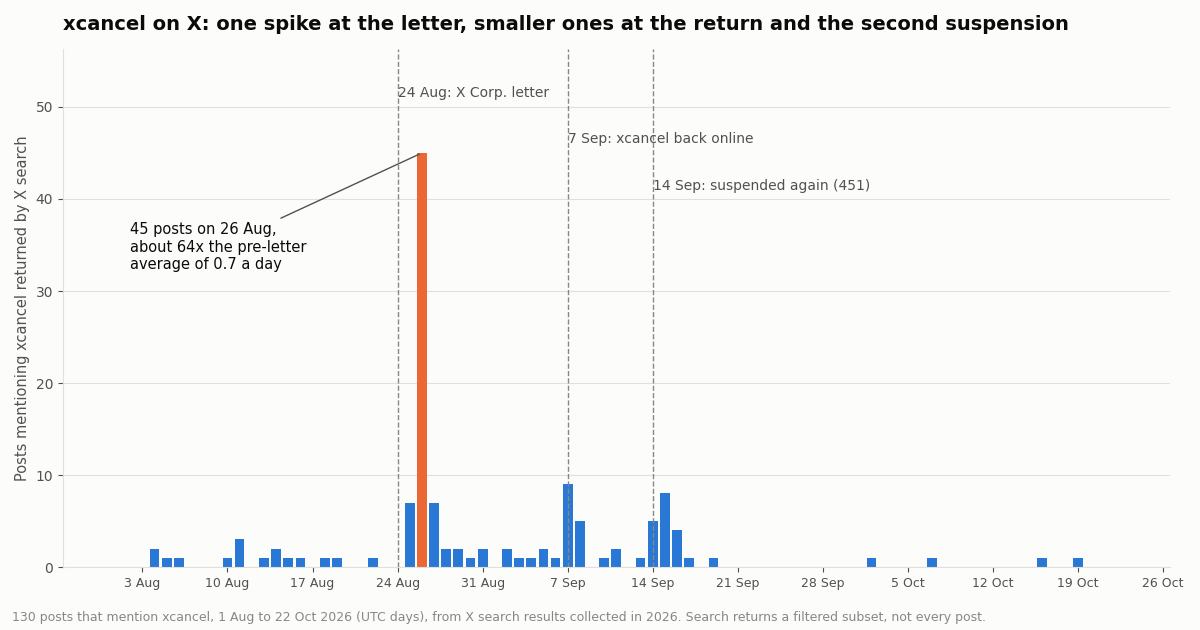
One spike, two echoes. In X's own search results for the word (method in the next section), before the letter there were about 0.7 posts a day about xcancel. On 26 August, the day the shutdown hit the news, it returned 45, about 64 times that. The return on 7 September and the second suspension on 14 and 15 September produced much smaller bumps (9 and 8 posts on their busiest days), and from 20 September on it averaged 0.12 a day.
What people posted on X when xcancel went down
To see how the shutdown landed with the people who used it, we pulled X's own search results for the word "xcancel" and kept the 313 posts whose text or links actually contain it (X search also matched 65 posts by an account with the word in its name, which we dropped). 130 of them were posted from the start of August 2026 onward, about three weeks before the letters (16 before them, 114 from the day of the letters on). X search returns a filtered subset of matching posts, so read the counts as relative, not as a census.
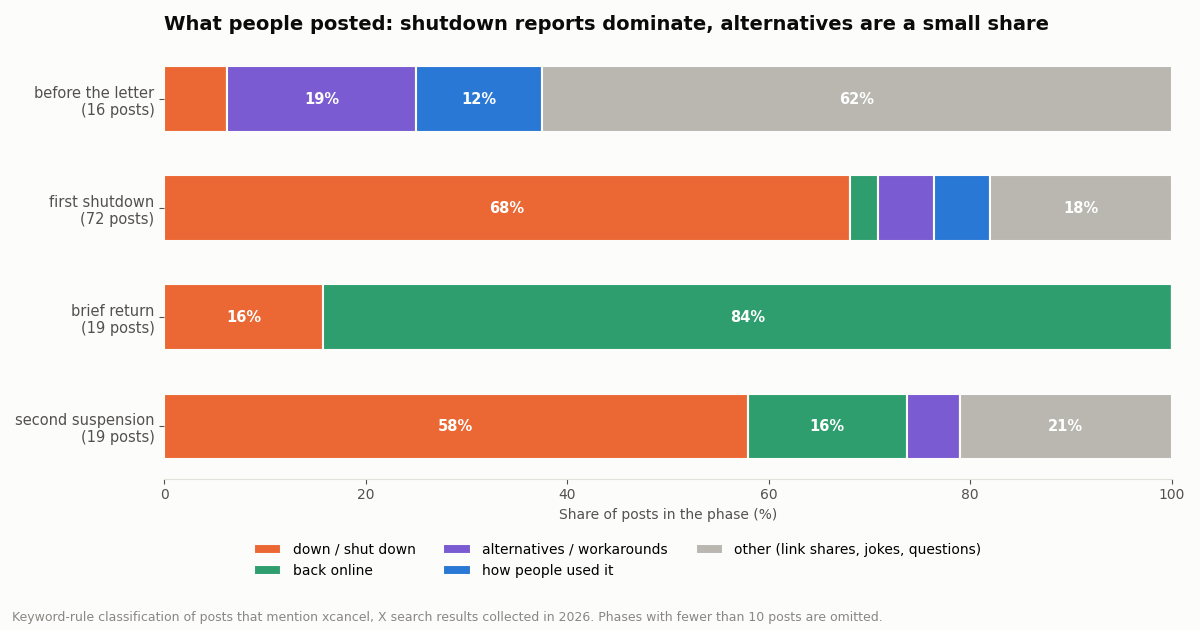
We sorted each post into one of five groups with simple keyword rules in several languages: reports that xcancel is down or shut down, reports that it is back, posts about alternatives or workarounds, posts describing how the writer used it, and everything else (bare link shares, jokes, questions).
The reaction was news, not a search for replacements. Across the whole window, 50.0% of posts reported xcancel down or shut, 16.2% reported it back, and only 6.2% discussed alternatives or workarounds. The posts that described usage name the same jobs again and again: sending a post to friends who have no X account, reading without logging in, downloading a video, and searching. 30.0% of the posts were not in English (French, Spanish, German and Japanese led), a reminder that xcancel links were shared well beyond English-speaking forums.
What that means if you landed here. Most people learned about the shutdown from a dead link, not from an announcement. The search for alternatives happens afterward and mostly off X, which is why the alternatives guide exists as a separate page.
Is xcancel safe? Is it legal to use?
Was it safe while it worked? By design it was more private toward X than x.com: your browser never contacted X, ran no X scripts and needed no account, which is the whole point of Nitter. The trade-off is that you were trusting xcancel's operator instead, an unnamed volunteer funded by donations, who received every request you made. There were no ads and, according to Nitter's feature list, no JavaScript was required. We are not aware of any reported xcancel data incident, but there is also no audit to point to.
Is it safe now? The domain serves a static notice with no scripts, no images and no third-party requests, so visiting it does nothing beyond showing that page. The practical risk is elsewhere: when we searched for the word in 2026, several results were auto-generated pages on unrelated domains that simply reuse "xcancel" as a keyword. A site that claims to be an xcancel mirror, asks you to sign in with your X account or wants a browser extension installed is not xcancel; the real one was a plain Nitter instance at one domain.
Was it legal to use? We are not lawyers, so take this as a summary of the public record, not advice. X's letters, as reported, were addressed to the Nitter project and its instance operators and concerned how they obtained X data (API use, accounts, session tokens) and X's trademarks. None of the coverage we read describes any action against people who read posts through an instance.
Is xcancel coming back? Nobody can say. Its notice offers no date and "can't share more details", and the Nitter maintainer wrote on 10 October 2026 that the project has no legal counsel. Plan as if it is not.
xcancel vs Nitter vs nitter.net, and reading X without a mirror
People use the three names interchangeably, but they are different things, and the difference explains why some Nitter sites still answer while xcancel does not.
Nitter vs xcancel in one line: Nitter is the engine, xcancel was one car. Volunteers still run a few public instances on the same code, with bot checks and frequent outages; the Nitter instances page lists what answered when we last probed them.
If you used xcancel for feeds or scripts. The underlying job, fetching a profile and its latest posts without an X account, is two read calls on an API. On twitterapi.io, GET /twitter/user/info returns the profile and GET /twitter/user/last_tweets returns the newest posts, 20 per page with has_next_page and next_cursor for older ones. No X account is needed and there is no session pool to get locked. Like xcancel, it only returns public accounts; protected (private) accounts' posts are never returned.
What it costs, against the official rate card. Tweet reads are $0.15 per 1,000 tweets returned (15 credits each, with a 15-credit minimum per request), and profiles $0.18 per 1,000. One profile plus its 20 newest posts is $0.00018 + $0.003, about $0.0032. On the official X API pay-per-usage rate card at docs.x.com/x-api/getting-started/pricing, the same check is $0.010 per user read plus 20 x $0.005 per post read, $0.11; per 1,000 posts it is $5 against $0.15, roughly 33 times more. New accounts that pass the automatic bot check get up to $1 of free credits (at most 100,000 credits, no card, one per person or network, expiring after 31 days); plans and limits are on the pricing page.
The script at the end of this page prints a profile and its latest posts, and can write an RSS file, which is the closest thing to an xcancel feed you can run yourself.
Looking to cancel X Premium or deactivate your X account?
Some people searching "x cancel" are not looking for xcancel at all, but for how to cancel an X Premium subscription or close an account. Those are settings inside X, not a website. X documents deactivation at help.x.com/en/managing-your-account/how-to-deactivate-x-account, and our guide to deactivating a Twitter (X) account walks through what happens step by step, including the 30-day window before the account is deleted.
One trap worth knowing: according to X's help center, deactivating an account does not cancel a Premium subscription bought through the App Store or Google Play. Cancel it in the store's subscription settings first; the deactivation guide covers the order of steps.
How we collected this
Question: what xcancel is and was, what it returns today, how its home page changed over time, and what people posted on X when it went down.
Live check: 26 requests in 2026 to six xcancel.com URLs (home, /about, /NASA, /NASA/rss, a search and a post URL), three per URL from one network and one per URL over a second network path, plus the http:// and www. variants, recording status code, time and size and saving the notice HTML.
Archive: the Wayback Machine CDX index for xcancel.com/ since 2024 (703 non-duplicate captures, classified by status code and page size, with the notice pages read in full), the archived About pages of May 2024 and August 2026, and a CDX query for archived 429 responses on any xcancel URL.
X posts: the twitterapi.io /twitter/tweet/advanced_search endpoint with the query xcancel, Latest order paginated back from 19 September 2026 and forward from 18 September, one day window around 26 August, and one Top pass for 1 August to 18 September, deduplicated: 378 posts returned, 313 actually mentioning xcancel, 130 in the window from 1 August 2026 on. 40 API requests in all, 8,910 credits ($0.09).
What the sample cannot show: X search returns a filtered subset of matching posts, so daily counts are relative, not totals; the keyword classification is approximate, especially for short or non-English posts; the live check is one moment from two networks; and the Wayback Machine visits on its own schedule, so the dates it shows are the first capture after a change, not the exact minute of it.
Privacy: aggregates only. Posts found by keyword search belong to private individuals: the raw pages were kept outside the study folder, and the committed sample holds only day, category, language, like and view counts, with no post ids, text, links or handles. Only public organizations and the xcancel and Nitter projects are named.
# Read an X profile and its latest posts the way xcancel showed them,
# and optionally write an RSS file (pip install requests).
import os
import sys
from email.utils import format_datetime
from datetime import datetime
from xml.sax.saxutils import escape

import requests

BASE = "https://api.twitterapi.io"
HEADERS = {"X-API-Key": os.environ["TWITTERAPI_IO_KEY"]}


def profile(user):
    r = requests.get(f"{BASE}/twitter/user/info", params={"userName": user}, headers=HEADERS, timeout=30)
    r.raise_for_status()
    body = r.json()
    if body.get("status") == "error" or not body.get("data"):
        sys.exit(f"@{user}: {body.get('msg', 'not found')}")
    return body["data"]


def latest_posts(user, pages=1):
    posts, cursor = [], ""
    for _ in range(pages):
        params = {"userName": user, "cursor": cursor}
        r = requests.get(f"{BASE}/twitter/user/last_tweets", params=params, headers=HEADERS, timeout=30)
        r.raise_for_status()
        data = r.json().get("data") or {}
        posts += data.get("tweets", [])
        if not r.json().get("has_next_page"):
            break
        cursor = r.json().get("next_cursor", "")
    return posts


def to_rss(user, posts):
    items = []
    for t in posts:
        when = datetime.strptime(t["createdAt"], "%a %b %d %H:%M:%S %z %Y")
        items.append(
            f"<item><title>{escape(t['text'][:80])}</title><link>{escape(t['url'])}</link>"
            f"<guid>{t['id']}</guid><pubDate>{format_datetime(when)}</pubDate>"
            f"<description>{escape(t['text'])}</description></item>"
        )
    return (f'<?xml version="1.0" encoding="UTF-8"?><rss version="2.0"><channel>'
            f"<title>@{user}</title><link>https://x.com/{user}</link><description>Latest posts</description>"
            + "".join(items) + "</channel></rss>")


if __name__ == "__main__":
    user = sys.argv[1] if len(sys.argv) > 1 else "NASA"
    p = profile(user)
    print(f"{p['name']} (@{p['userName']}) | {p['followers']:,} followers | {p['statusesCount']:,} posts")
    print(p.get("description", ""), "\n")
    posts = latest_posts(user, pages=1)  # 20 posts per page, about $0.003 for a full page
    for t in posts:
        print(t["createdAt"], "|", t["likeCount"], "likes |", t["text"].replace("\n", " ")[:120])
    if "--rss" in sys.argv:
        with open(f"{user}.xml", "w", encoding="utf-8") as f:
            f.write(to_rss(user, posts))
        print(f"\nwrote {user}.xml")
Questions readers ask
What is xcancel?
xcancel (xcancel.com, first called "X Cancelled") was a public instance of Nitter, the open-source front end for reading X (Twitter) without an account, JavaScript or ads. You replaced x.com with xcancel.com in a link and its server fetched the page from X for you. It has been suspended since 14 September 2026 and returns HTTP 451.
Is xcancel the same as Nitter?
No. Nitter is the software; xcancel was one independent site running it, operated by people separate from the Nitter project according to its own About page. nitter.net is the project's own instance, which now shows only the maintainer's notice. Some other volunteer instances still answer intermittently.
Why does xcancel say the service is suspended?
X Corp. sent cease-and-desist letters to the Nitter project and its instances on 24 August 2026. xcancel stopped on 25 August, came back on 7 September, and on 14 September suspended again, citing "a new development in the ongoing legal proceedings". It serves that notice with HTTP 451 on every URL.
Is xcancel safe to use?
While it worked, it kept X from seeing your browser, but the xcancel operator received your requests. Today the domain only serves a static notice with no scripts. Be wary of sites that claim to be xcancel mirrors and ask for an X login or an extension; the real xcancel never needed either.
What did "too many requests" mean on xcancel?
It was a rate limit (HTTP 429). xcancel shared a small pool of X sessions among all its readers, and both X and the instance cap how fast those sessions can be used. The Wayback Machine holds 13 archived 429 pages from xcancel in early 2025. Waiting and retrying usually worked; the current 451 will not clear by retrying.
Does xcancel RSS still work?
No. Feeds at xcancel.com/username/rss return the same HTTP 451 notice as HTML, which feed readers treat as an error. To keep a feed for an X account you can self-host Nitter with your own X accounts, find a public instance that still serves RSS, or build the feed from an API.
Is there an xcancel GitHub repository?
The site linked to the Nitter repository at github.com/zedeus/nitter rather than a repository of its own. That repository was archived (read-only) by its owner on 9 October 2026 and its README leads with the cease-and-desist notice.
Will xcancel come back?
There is no announced date. Its notice says it "can't share more details", and the Nitter maintainer wrote on 10 October 2026 that the project has no legal counsel. For now, open original x.com links or use one of the alternatives.
Continue
- Nitter on GitHub: project description, feature list, 24 August 2026 cease-and-desist notice, 10 October 2026 update, archived 9 October 2026
- TechCrunch: Nitter and XCancel are dead (again) after X's latest legal actions (September 2026)
- The Next Web: Nitter offline after cease-and-desist letters; deadline and laws cited
- Wikipedia: Nitter, dated history from the 2019 launch to xcancel's 14 September 2026 suspension
- RFC 7725: the HTTP 451 Unavailable For Legal Reasons status code
- X API pay-per-usage pricing ($0.005 per post read, $0.010 per user read)
- X (Twitter) API hub: how reading X data works
- xcancel alternatives we tested, and which still work
- Working Nitter instances: our live probe of 18 hosts
- Nitter alternatives for private reading, RSS and scraping
- Deactivating a Twitter (X) account, step by step
- Build a Twitter (X) to RSS feed from the API
- What logged-out X (the web viewer) still shows
- twitterapi.io pricing and plans
- 01GetXBot: What the Twitter (X) Video Bot Is, Whether It Is Safe, and Alternatives
- 02The Best Twitter (X) Accounts to Follow, by Topic
- 03Twitter (X) Media Viewer: How to Browse an Account's Photos and Videos
- 04AllMyTweets: What It Did, Its Limits, and How to See Every Tweet on Twitter (X)
- 05Twitter (X) Private Profile Viewer: Can You See Protected Tweets?
- 06xcancel Not Working? The xcancel Alternatives That Still Work
- 07Download Twitter (X) Media — Bulk API Workflow (Photos + Videos)
- 08Nitter Is Archived: Which Nitter Alternatives Still Work in 2026?
Stop reading. Start building.
Starter credits cover real testing on real data. Google sign-in, no card, no application queue.
Get an API key