Kiro vs Claude Code: Credits, Specs, Hooks, CLI and MCP Compared for Twitter (X) Data Builds
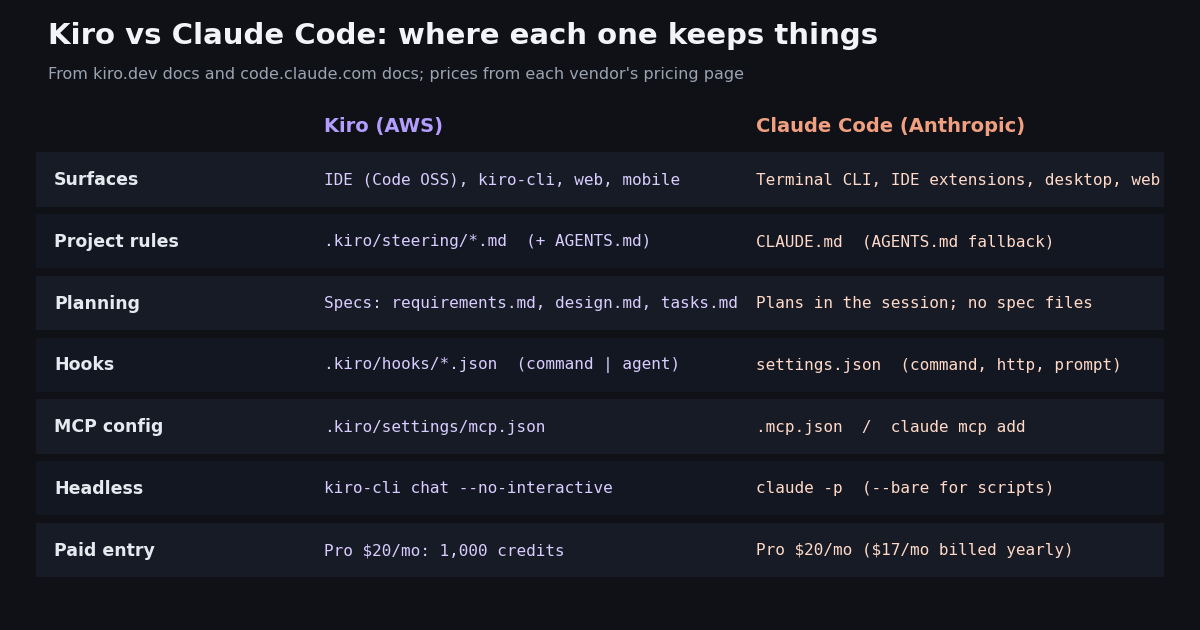
- Different centers: Kiro is an IDE (Code OSS) plus
kiro-cli, built around specs (requirements.md,design.md,tasks.md); Claude Code is a terminal agent with IDE, desktop and web surfaces, steered byCLAUDE.md. - Credits vs limits: Kiro Pro is $20 for 1,000 credits ($0.04 per extra credit), and a model's multiplier decides how fast they go (Opus 5.5 2.0x, Sonnet 1.3x, Auto 1.0x). Claude Pro is $20 with 5-hour and weekly usage limits; Max $100, Ultra $200.
- Free tiers: Kiro Free gives 50 credits a month; Claude Free does not include Claude Code. Kiro's headless API keys need Pro or above.
- Same building blocks, different files: steering in
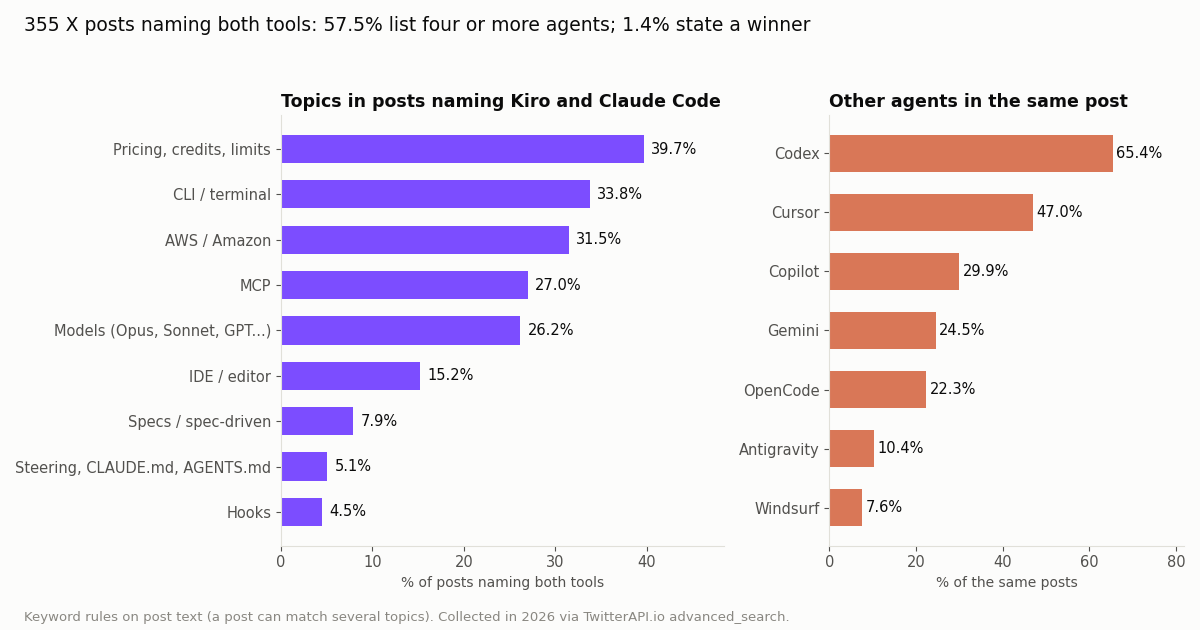
.kiro/steering/vsCLAUDE.md; hooks in.kiro/hooks/*.jsonvssettings.json; MCP in.kiro/settings/mcp.jsonvs.mcp.json; headlesskiro-cli chat --no-interactivevsclaude -p. - What X says: in 355 posts naming both (collected in 2026), 57.5% list four or more coding agents, Codex appears in 65.4%, pricing or credits in 39.7%, and only 1.4% name a winner.
- X data costs the same in both: either agent calls TwitterAPI.io at $0.15 per 1,000 posts returned, against $0.005 per post read ($5 per 1,000) on the official X API pay-per-usage rate card, about 33x.
Kiro vs Claude Code is mostly a question of workflow and billing, not raw model quality: Kiro can run Anthropic's Claude models itself, and both tools read project rules, run hooks, connect MCP servers and run headless. This page compares them on the parts that change your day: plans and what a dollar buys, specs vs in-session planning, steering vs CLAUDE.md, hooks, MCP setup and headless runs. Every price, file path and flag below was read from kiro.dev and from Anthropic's claude.com/pricing and code.claude.com/docs for this page. We did not benchmark the two agents, so there are no speed or accuracy claims here.
To keep it concrete, both tools get the same job: write and run a small monitor that watches X (Twitter) for new posts on a query and prints a digest. You will see the same MCP server and the same script wired into each, and what the X data costs. We also measured how the two tools are discussed on X, from the official @kirodotdev and @claudeai accounts and a de-identified sample of posts that name both. If you want the longer Kiro build walkthrough, our hand-written guide to building Twitter apps with the Kiro AI IDE covers it step by step.
about 194 to 1
Kiro vs Claude Code at a glance
The short version, from each vendor's documentation and pricing page as read for this comparison:
Who builds what. Kiro's site says it is built and operated by AWS, that you sign in with GitHub, Google, AWS Builder ID or IAM Identity Center, and that no AWS account is needed. Because it is based on Code OSS, it imports VS Code settings, themes and Open VSX extensions. Claude Code installs with one native installer command (from claude.ai/install.sh on macOS, Linux and WSL) and runs in any terminal; its docs say every surface shares the same engine, so CLAUDE.md, settings and MCP servers carry over between them.
The honest overlap. The two now share most building blocks: both have hooks, MCP, subagents, skills, headless runs and cloud sessions. The real differences are the spec workflow, the editor, the model menu and how usage is billed.
Pricing: Kiro credits vs Claude plan limits
Prices below are copied from kiro.dev/pricing and claude.com/pricing as read for this page, in US dollars per month. Both vendors say plans change, so check before you buy.
What a Kiro credit is. Kiro's FAQ calls a credit "a unit of work in response to user prompts": a simple prompt can cost less than one, a spec task usually costs more, and usage is metered to two decimal places with a 0.01 minimum. Vibe mode, spec mode, spec refinement, task execution and agent hook execution all draw credits. Extra credits on the individual plans cost $0.04 each. A first upgrade from Free to Pro makes the rest of that month free and adds 500 trial credits usable within 12 months.
Model multipliers decide the real price. Kiro's models page prices each model relative to Auto (1.0x). From that table: Claude Opus 5.5 is 2.0x, Opus 5 and Opus 4.8 are 2.2x, Sonnet 5.5, Sonnet 5 and Sonnet 4.6 are 1.3x, Haiku 5.5 is 0.06x (0.3x above 100K tokens), GPT-5.6 Sol 4.4x, Terra 2.2x and Luna 0.6x, and open-weight models such as DeepSeek 3.2 (0.25x), GLM-5 (0.5x) and Qwen3 Coder Next (0.05x) are cheaper. Claude Fable 5.1 is listed at 6x for Enterprise only. So 1,000 Pro credits stretch much further on Auto or Haiku than on Opus.
Claude's limits are time windows, not a credit count. Every paid Claude plan meters usage every 5 hours and every week; Max is 5x Pro, and Ultra drops the 5-hour limit for verified accounts and gives 10x Pro weekly. The pricing page says real limits depend on the model, chat length and file size. Our Claude Code pricing guide covers those limits, API-key billing and Enterprise in detail, so we do not repeat it here.
Which bill is easier to predict? Kiro shows a number that goes down and can be topped up at a fixed $0.04; Claude shows a window that resets. Heavy Opus use burns Kiro credits at 2x or more, while on Claude it eats into the 5-hour window. Neither vendor publishes a conversion between the two, so any "Kiro credits per Claude message" figure is a guess.
Specs, steering and hooks
This is the feature Kiro is known for. A Kiro spec turns a request into three files: requirements.md (user stories and acceptance criteria, or bugfix.md for a bug spec), design.md (architecture, sequence diagrams, implementation notes) and tasks.md (a trackable implementation plan). Feature specs come in Requirements-First and Design-First variants, and Quick Spec generates all three files without the approval gates.
Running a spec is where it differs from a to-do list. You can run tasks one at a time or all together; when you run all, Kiro builds a dependency graph and groups independent tasks into waves. Its docs put it as "Waves execute sequentially; tasks within a wave execute concurrently." Tasks run in the IDE, the CLI and the web, and each task draws credits.
Claude Code has no spec file format. Its overview says it "plans the approach, writes the code across multiple files, and verifies it works" within the session, and its VS Code extension offers plan review. It can spawn subagents for parallel parts of a task, and you can of course ask it to write a requirements or design document first, but nothing in Claude Code enforces that shape.
What that means for an X monitor. For a small script, a spec is overhead: you would approve three documents for 60 lines of Python. For a multi-part build (a poller, a database, a dashboard and alerting), Kiro's written requirements give you a reviewable record and parallel waves, which is why teams that like design docs gravitate to it. Our hand-written Kiro guide walks through exactly that kind of build.
Project rules. Kiro reads steering files from .kiro/steering/ in the workspace and ~/.kiro/steering/ globally; workspace steering wins on conflict. The default project files are product.md, tech.md and structure.md, and each file has an inclusion mode: always (default), fileMatch, manual or auto. Kiro also reads AGENTS.md from the workspace root, subfolders and ~/.kiro/steering/. Claude Code reads CLAUDE.md at the start of every session and reads AGENTS.md in its place when a repository has only that, so an AGENTS.md is the one file both tools honor.
Hooks. Kiro hooks are JSON files in .kiro/hooks/ (and ~/.kiro/hooks/ globally in CLI V3), each with a version of v1 and a hooks array. Triggers include Prompt Submit, Agent Stop, Session Start, Pre Tool Use, Post Tool Use, File Create, File Save, File Delete, and Pre and Post Task Execution for spec tasks. An action is either a shell command (60-second default timeout, session context as JSON on stdin) or an agent prompt injected into the conversation; agent hook execution draws credits.
Claude Code hooks live in settings.json (user, project or local), in plugins, skills and subagent frontmatter. The docs list over 30 events, from SessionStart and UserPromptSubmit to PreToolUse, PostToolUse, Stop, TaskCompleted, FileChanged and PreCompact, and five handler types: command, http, mcp_tool, prompt and agent. Exit code 2 is the blocking signal: on PreToolUse it blocks the tool call. Our Claude Code hooks guide covers the full event list.
Kiro matches file triggers with a regex against the file path, so \.py$ below means any Python file. Both hook files do the same thing: run the monitor's tests after the agent edits Python. Note that Kiro's spec-task triggers (Pre and Post Task Execution) have no direct Claude Code twin, while Claude Code's http and mcp_tool handler types have none in Kiro.
// Kiro: .kiro/hooks/x-monitor-tests.json
{
  "version": "v1",
  "hooks": [
    {
      "name": "test the X monitor after edits",
      "trigger": "PostFileSave",
      "matcher": "\\.py$",
      "action": { "type": "command", "command": "python -m pytest -q tests/test_monitor.py" }
    }
  ]
}

// Claude Code: .claude/settings.json
{
  "hooks": {
    "PostToolUse": [
      {
        "matcher": "Edit|Write",
        "hooks": [
          { "type": "command", "command": "python -m pytest -q tests/test_monitor.py" }
        ]
      }
    ]
  }
}MCP: one X data server in both tools
Both tools speak the Model Context Protocol, so one remote server serves both. We use TwitterAPI.io's hosted server at https://mcp.twitterapi.io/mcp, which takes your API key as a Bearer token in the Authorization header (the same form our MCP quickstart shows for every client).
Kiro. MCP servers live in .kiro/settings/mcp.json (workspace) or ~/.kiro/settings/mcp.json (user); if both exist they merge and the workspace wins. A remote server takes url and optional headers, plus env, oauth, disabled, autoApprove and disabledTools. Kiro expands ${VARIABLE_NAME} only for variables you have approved, and shows a security warning otherwise; in the IDE you approve them under the "Mcp Approved Env Vars" setting. The same file serves the IDE, kiro-cli and web.
Claude Code. One command adds the server: claude mcp add --transport http with a --header for the key. --scope user makes it available in every project; --scope project writes a .mcp.json the team can commit, and Claude Code expands ${VAR} in its headers so the key never lands in the repository. Our MCP server guide lists the tools the server exposes and shows the same setup for Cursor and other clients.
Once connected, you can ask either agent things like "find the 20 most-liked posts this week that mention our product and draft a summary", and it calls the X search tool for you. For scheduled or high-volume work, a plain script (below) is cheaper on model usage than having the agent call tools turn by turn.
# ---------- Kiro (IDE and kiro-cli read the same file) ----------
# .kiro/settings/mcp.json  (workspace)  or  ~/.kiro/settings/mcp.json  (user)
{
  "mcpServers": {
    "twitterapi-io": {
      "url": "https://mcp.twitterapi.io/mcp",
      "headers": { "Authorization": "Bearer ${TWITTERAPI_IO_API_KEY}" }
    }
  }
}
# Kiro only expands variables you have approved:
# IDE settings -> search "Mcp Approved Env Vars" -> add TWITTERAPI_IO_API_KEY

# ---------- Claude Code ----------
claude mcp add --transport http --scope user twitterapi-io https://mcp.twitterapi.io/mcp \
  --header "Authorization: Bearer $TWITTERAPI_IO_API_KEY"

# or commit .mcp.json at the repo root (Claude Code expands ${VAR} in headers)
{
  "mcpServers": {
    "twitterapi-io": {
      "type": "http",
      "url": "https://mcp.twitterapi.io/mcp",
      "headers": { "Authorization": "Bearer ${TWITTERAPI_IO_API_KEY}" }
    }
  }
}Headless runs: kiro-cli vs claude -p
Both tools run without a person at the keyboard, which is what you want for a scheduled X digest or a CI job.
Kiro CLI. From version 3.0.0 kiro-cli is a single binary for macOS, Linux and Windows, installed with a one-line script from cli.kiro.dev/install. Headless runs use kiro-cli chat --no-interactive "prompt" (or a prompt on stdin), authenticated with KIRO_API_KEY. API keys are available only on Pro, Pro+, Pro Max and Power. Tool calls that need approval are denied in non-interactive mode unless you pass --trust-tools=<ids> or --trust-all-tools, and --output-format stream-json writes JSON Lines events. Steering, custom agents, hooks, permissions and MCP servers all apply in the CLI's V3 harness.
Claude Code. claude -p "prompt" runs non-interactively; --bare skips auto-discovery of hooks, skills, plugins, MCP servers and CLAUDE.md for reproducible scripts and needs ANTHROPIC_API_KEY rather than your subscription login. --output-format json returns the result with total_cost_usd, --json-schema returns a structured_output field, and --allowedTools uses permission rules such as Bash(git diff *). In bare mode, pass MCP servers with --mcp-config.
The practical difference: Kiro's headless mode needs a paid plan for the key, while Claude Code's bare mode bills the Anthropic API per token instead of your plan. Both deny unapproved tools in unattended runs, so list exactly the commands the job needs.
# Kiro CLI (API keys: Pro, Pro+, Pro Max and Power plans only)
curl -fsSL https://cli.kiro.dev/install | bash
export KIRO_API_KEY=...            # created in the Kiro portal
kiro-cli chat --v3 --no-interactive --trust-all-tools \
  "Run python x_mentions_monitor.py and summarize what changed"
# tools you do not trust are denied in non-interactive mode, so name them
# with --trust-tools=<ids> or use --trust-all-tools in a sandboxed runner

# Claude Code
curl -fsSL https://claude.ai/install.sh | bash
export ANTHROPIC_API_KEY=...       # --bare skips your subscription login
claude --bare -p "Run python x_mentions_monitor.py and summarize what changed" \
  --allowedTools "Bash(python x_mentions_monitor.py *),Read" \
--output-format json # result + total_cost_usdHow Kiro and Claude Code are discussed on X
We searched X for recent posts containing both "kiro" and "claude code" and kept 355 after removing duplicates and posts where one name only appeared in a link. Over the 94-day span of the newest results, that is about 3.4 posts a day. 60.3% were in English and 20.0% in Japanese, with Chinese (10.1%), Spanish and Korean behind.
It is rarely a two-horse race. 80.8% of these posts name at least one other agent and 57.5% name four or more in total: Codex appears in 65.4%, Cursor in 47.0%, Copilot in 29.9% and Gemini in 24.5%. Most are tool lists, setup threads and "what I use" posts rather than head-to-head reviews.
Price comes up more than specs. Pricing, credits or limits appear in 39.7% of posts (43.5% of English ones), and MCP in 27.0%, while Kiro's signature spec workflow appears in only 7.9%. Only 1.4% of posts state a clear preference by our keyword rules (2 lean Kiro, 3 lean Claude Code), far too few to call a winner. The median post had 5 likes and 912 views; the top tenth reached 88 likes or more.
Share of voice and the official accounts
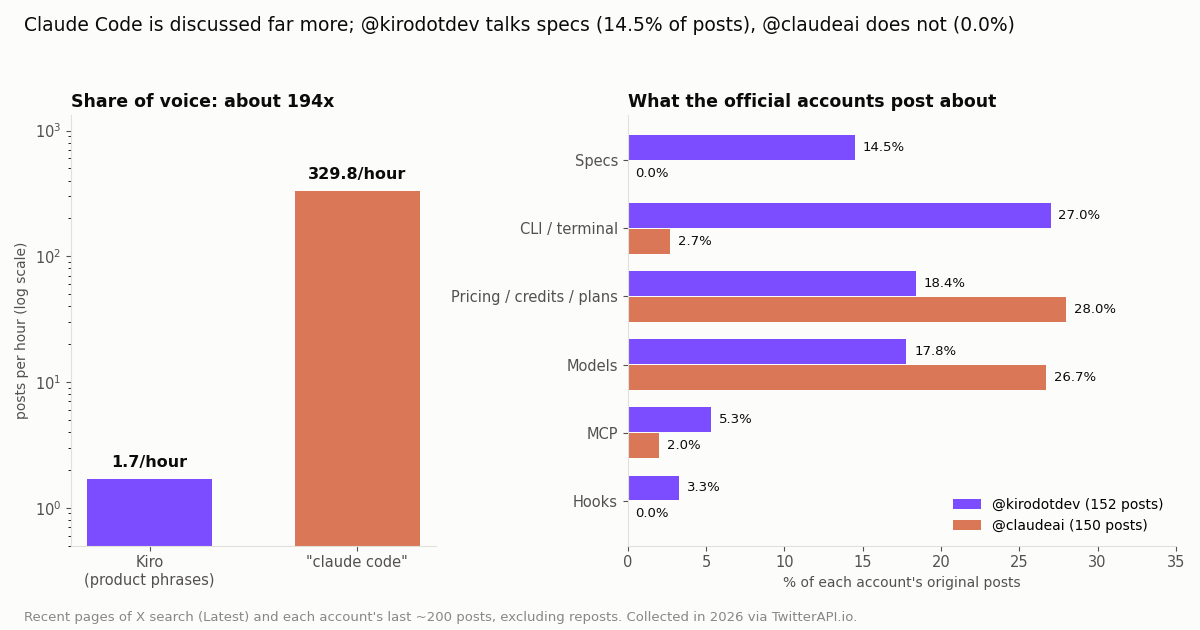
Share of voice. Over the most recent search pages, posts containing "claude code" arrived at about 329.8 an hour, against about 1.7 an hour for posts with Kiro product phrases (kiro.dev, @kirodotdev, "kiro ide", "kiro cli", "kiro ai", "aws kiro", "amazon kiro"). That is roughly 194 to 1. The Kiro query undercounts posts that say only "Kiro", because the bare word is also a personal name; even so, Claude Code is discussed on X at a very different scale.
Same rhythm, different reach. Both official accounts post about once every two days (0.53 and 0.54 original posts a day over their last ~200 posts). @claudeai, with 1,999,562 followers against Kiro's 22,660 at collection time, gets a median of 13,101 likes per post; @kirodotdev gets 55.
Different message. 14.5% of @kirodotdev's posts mention specs and 27.0% the CLI or terminal, which matches Kiro's push of kiro-cli toward Claude Code's home turf. @claudeai never mentions specs (0.0%) and talks more about models (26.7%) and plans or pricing (28.0%), since it promotes the whole Claude product rather than Claude Code alone.
The X data bill, and which one to pick
Your Kiro credits or Claude plan pay for the model. The X data is a separate bill and it is identical in both tools, because both call the same MCP server or the same REST endpoint. TwitterAPI.io bills tweet endpoints such as /twitter/tweet/advanced_search and /twitter/user/last_tweets at 15 credits per post returned, which is $0.15 per 1,000 posts, with a 15-credit minimum per request: a check that finds nothing costs $0.00015, and a full 20-post page costs $0.003. Profiles from /twitter/user/info are $0.18 per 1,000. You pay only for the data returned.
On the official X API rate card at docs.x.com/x-api/getting-started/pricing, pay-per-usage reads cost $0.005 per post and $0.010 per user, capped at 3 million post reads per monthly billing cycle (Enterprise above that), and new payers get $20 of credits on a first eligible card plus a match up to $50. Per 1,000 posts that is $5 against $0.15, roughly 33x.
For scale, this page's whole study (1,006 posts and two profiles over 54 requests) cost about $0.15 in data. New TwitterAPI.io accounts that pass the automatic bot check get up to $1 of free credits (at most 100,000 credits, no card, one per person or network, expiring after 31 days); purchased credits never expire. Rate limits are 0.2 requests per second before the first payment and 20 once paid. Reads need no X account. If the monitor should also post, write endpoints such as /twitter/create_tweet_v2 run through an authenticated session: one /twitter/user_login_v2 login ($0.10, with a proxy you supply) returns login_cookies, and each action is 60 credits ($0.0006), billed per HTTP 200 call. The call acts as that account, so X can rate-limit, lock or suspend it; keep a human pace, and expect the session to need a re-login now and then.
Pick Kiro if you want an IDE, written specs that the team can review, parallel task waves, and one credit balance that covers Claude, GPT-5.6 and open-weight models, or if your company already signs in through AWS IAM Identity Center. Kiro Free (50 credits) is enough to try a spec end to end.
Pick Claude Code if you work in the terminal, want Anthropic's models first, need the widest hook surface (http, mcp_tool, blocking exit codes) and scripted runs with --bare, --json-schema and per-run cost in the output. Note that it needs a paid Claude plan or an API key.
Or use both. Nothing stops you: put shared rules in AGENTS.md, which both tools read, and point both at the same MCP server. If you are still shopping, our Cursor vs Claude Code and Codex vs Claude Code comparisons cover the other names that show up in most of these X posts.
How we collected this
Question. How loud is Kiro next to Claude Code on X, what do posts naming both discuss, and what do the official accounts post about?
Accounts and queries. Official accounts @kirodotdev and @claudeai (organization accounts, last ~200 posts each via /twitter/user/last_tweets, replies excluded). Posts naming both: /twitter/tweet/advanced_search with kiro "claude code" -filter:retweets, Latest (20 pages) and Top (5 pages), deduplicated, then kept only where both names appear in the post text (355 posts). Share of voice: Latest pages for "claude code" -filter:retweets and for a Kiro product-phrase query, divided by each sample's time span.
Window and size. The most recent posts at collection time, collected in 2026: 1,006 posts returned across 54 requests, about $0.15 in data. Topics and preferences are case-insensitive keyword rules on the post text; the rules are in data/studies/kiro-vs-claude-code/analyze.py.
What it cannot show. Keyword rules miss sarcasm, images and paraphrase, and a post can match several topics. Recent posts are not a random sample of all opinion. The share-of-voice figure compares short recent windows, and the Kiro side undercounts posts that say only "Kiro". Nothing here measures which tool writes better code.
Privacy. Aggregates only. The two official accounts are organizations; posts from searches belong to private individuals, so their raw pages were not kept in the repository, the sample file holds de-identified rows (no id, URL, text or handle), and no individual is profiled or quoted.
"""x_mentions_monitor.py - the X-data job we hand to both Kiro and Claude Code in this comparison.

Polls TwitterAPI.io advanced search for new posts matching a query, keeps the newest post id
in a state file, and prints a short markdown digest. Kiro or Claude Code can write, test and
run it headless; the X data bill is the same either way.

    pip install requests
    export TWITTERAPI_IO_API_KEY=...      # twitterapi.io dashboard
    python x_mentions_monitor.py '"your product" -filter:retweets'
"""
import json
import os
import sys
from pathlib import Path

import requests

BASE = "https://api.twitterapi.io"
HEADERS = {"X-API-Key": os.environ["TWITTERAPI_IO_API_KEY"]}
STATE = Path("monitor_state.json")
MAX_PAGES = 5  # 20 posts per page; each page with posts costs $0.003, an empty one $0.00015


def search(query, max_pages=MAX_PAGES):
    """Yield posts newest first, following next_cursor."""
    cursor = ""
    for _ in range(max_pages):
        r = requests.get(
            f"{BASE}/twitter/tweet/advanced_search",
            headers=HEADERS,
            params={"query": query, "queryType": "Latest", "cursor": cursor},
            timeout=30,
        )
        r.raise_for_status()
        body = r.json()
        for t in body.get("tweets", []):
            yield t
        if not body.get("has_next_page"):
            break
        cursor = body.get("next_cursor", "")


def main():
    query = sys.argv[1] if len(sys.argv) > 1 else '"claude code" kiro -filter:retweets'
    state = json.loads(STATE.read_text()) if STATE.exists() else {}
    last_id = int(state.get(query, 0))
    fresh = []
    for t in search(query):
        if int(t["id"]) <= last_id:
            break  # newest first: everything after this was seen on an earlier run
        fresh.append(t)
    if fresh:
        state[query] = max(int(t["id"]) for t in fresh)
        STATE.write_text(json.dumps(state, indent=1))
    print(f"## {len(fresh)} new posts for {query}")
    for t in sorted(fresh, key=lambda t: t.get("likeCount", 0), reverse=True)[:10]:
        author = t.get("author") or {}
        text = (t.get("text") or "").replace("\n", " ")[:160]
        print(f"- {t.get('likeCount', 0)} likes, {t.get('viewCount', 0)} views "
              f"(@{author.get('userName')}, {t.get('createdAt')}): {text} {t.get('url')}")


if __name__ == "__main__":
    main()
Researching this?Free starter credits cover end-to-end testing — Google sign-in, no card. Get a key.
Questions readers ask
Is Kiro better than Claude Code?
Neither vendor publishes a like-for-like benchmark and we did not run one. Kiro can use Anthropic's own Claude models, so the difference is workflow and billing: Kiro adds specs, an IDE and credits; Claude Code is terminal-first with plan-based usage limits. On X only 1.4% of 355 posts naming both stated a clear preference.
Does Kiro use Claude?
Yes. Kiro's models page lists Claude Opus 5.5, Opus 5, Opus 4.8, Sonnet 5.5, Sonnet 5, Sonnet 4.6, Haiku 5.5 and others, each with a credit multiplier (Opus 5.5 is 2.0x, Sonnet 1.3x), alongside GPT-5.6 models, open-weight models and an Auto router at 1.0x. Claude Fable 5.1 is Enterprise only.
How much does Kiro cost compared with Claude Code?
Both start at $20 a month. Kiro Pro is $20 for 1,000 credits, Pro+ $40, Pro Max $100 and Power $200, with extra credits at $0.04. Claude Code comes with Claude Pro ($20 monthly or $17 a month billed annually), Max ($100) and Ultra ($200). Kiro has a free tier with 50 credits; Claude Free does not include Claude Code.
What is the difference between Kiro CLI and Claude Code?
Both are terminal agents. kiro-cli uses Kiro's steering, specs, hooks and MCP config from .kiro/, bills Kiro credits, and runs headless with kiro-cli chat --no-interactive and a KIRO_API_KEY (Pro and above). Claude Code uses CLAUDE.md, settings.json hooks and .mcp.json, and runs headless with claude -p.
Can Kiro and Claude Code share the same project instructions?
Partly. Both read AGENTS.md: Kiro from the workspace root, subfolders and ~/.kiro/steering/, Claude Code when a repository has no CLAUDE.md. Kiro's .kiro/steering/ files and Claude Code's CLAUDE.md are tool-specific.
Do I need an AWS account to use Kiro?
No. Kiro's site says you can sign in with GitHub, Google, AWS Builder ID or AWS IAM Identity Center, and that an AWS account is not required.
How do I give Kiro or Claude Code access to X (Twitter) data?
Add a remote MCP server: in Kiro, an entry with url and an Authorization header in .kiro/settings/mcp.json; in Claude Code, claude mcp add --transport http with a --header. TwitterAPI.io's server at mcp.twitterapi.io/mcp takes your API key as a Bearer token. Reads cost $0.15 per 1,000 posts returned and need no X account.
What do Kiro credits get used for?
Kiro's pricing FAQ says vibe mode, spec mode, spec refinement, task execution and agent hook execution all use credits. A simple prompt can cost under one credit, spec tasks usually more, metered to two decimals with a 0.01 minimum, and the model's multiplier scales the cost.
Continue
- Kiro pricing: Free, Pro, Pro+, Pro Max, Power, credits and add-ons
- Kiro docs: Models and credit multipliers
- Kiro docs: Specs (requirements.md, design.md, tasks.md, waves)
- Kiro docs: Kiro CLI headless mode (KIRO_API_KEY, --no-interactive)
- Claude plans and pricing (Free, Pro, Max, Ultra, Team, Enterprise)
- Claude Code docs: Run Claude Code programmatically (claude -p, --bare)
- X (Twitter) API guide: endpoints, pricing and access options
- Building Twitter (X) apps with the Kiro AI IDE, step by step
- Claude Code pricing and usage limits explained
- Cursor vs Claude Code comparison
- Codex vs Claude Code: setup, MCP and headless runs
- Claude Code hooks: every event and handler type
- What an MCP server is, with the hosted X data server
- TwitterAPI.io pricing: pay per post returned
- 01Devin Pricing in 2026: Plans, Quotas, ACUs and What X Users Actually Pay
- 02Lovable Alternatives in 2026: Bolt.new, v0, Base44, Replit, Emergent and Cursor Compared
- 03Kiro vs Cursor in 2026: Plans, Spec-Driven vs Agent-First, and X (Twitter) Data via MCP
- 04Langfuse vs LangSmith: Pricing, Self-Hosting, OpenTelemetry and an X-Data Agent Traced in Both
- 05n8n vs Zapier vs Make in 2026: Pricing, Self-Hosting, AI Agents and the Same Twitter (X) Flow Built in All Three
- 06OpenClaw vs Claude Code: which agent should run your Twitter (X) jobs?
- 07Claude Code Channels: Telegram, Discord and Twitter (X) Alerts in Your Session
- 08Claude Code Alternatives: Seven Coding Agents Checked for License, Free Use and MCP (Twitter/X Data Included)
Writing about something you built with TwitterAPI.io? Our community rewards program pays API credits for honest tutorials, build logs and videos.
Stop reading. Start building.
Starter credits cover real testing on real data. Google sign-in, no card, no application queue.
Get an API keyAlready building with TwitterAPI.io? Publish an honest tutorial or build log about it and earn up to $200 a month in API credits.